Bullish Turnaround in Markets?
Our Analysis Overview shows more and more Bullish signals appearing. Is the market correction over?
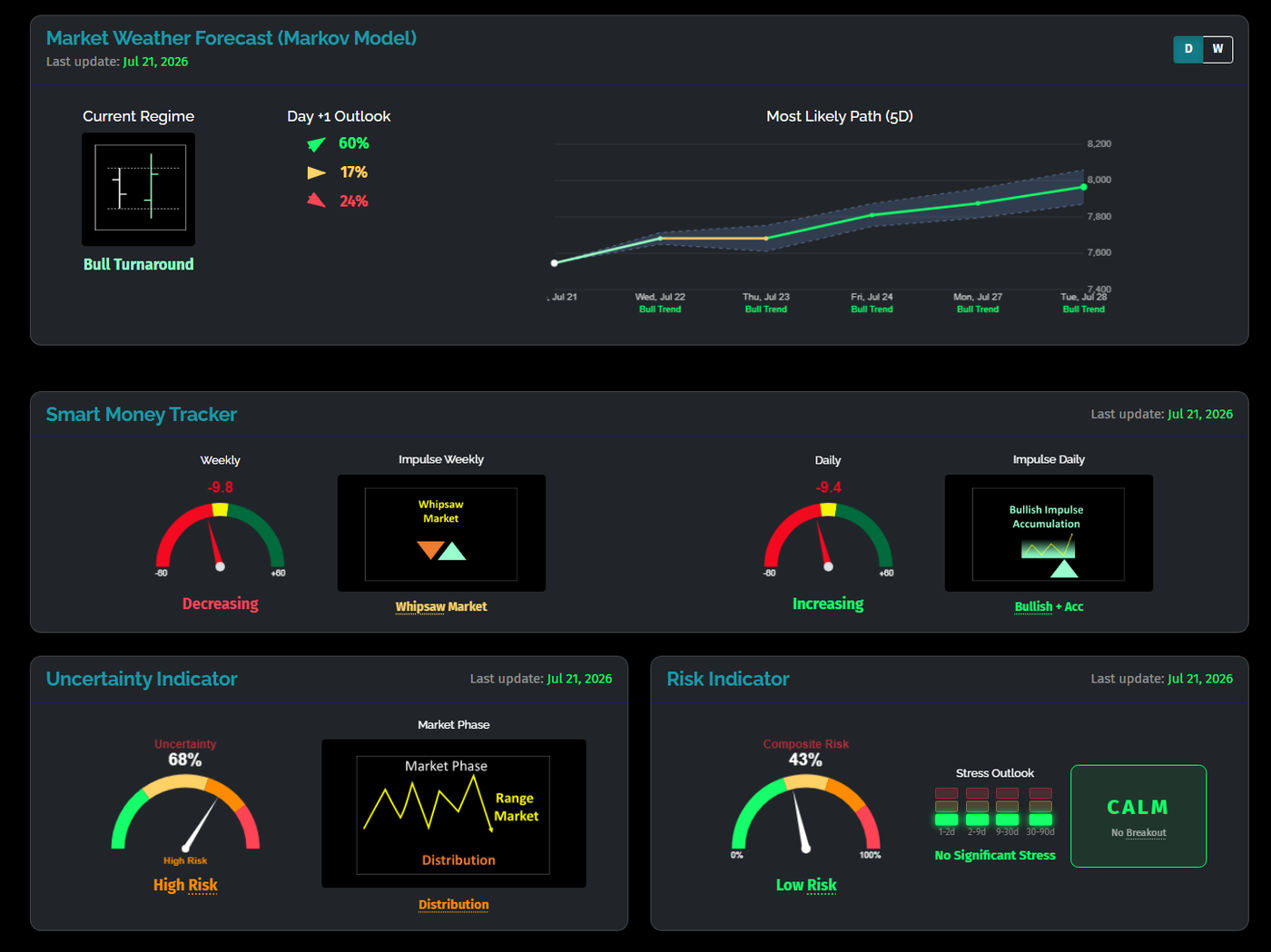
Markets in Vitro - Signal Overview
Notably, while Entropy is still in Distribution regime, the Markov Model suggests a high probability for short-term upward moves and the Smart Money Tracker detected a Bullish Impulse on Monday, followed by an impressive Accumulation on Tuesday.
Wall Street’s Earnings-Playbook
Over the last 6 years, the market almost never failed to pull back. With Retail-Traders often buying the dip so heavily that institutional money lagged behind and needed to play catch-up in a rallying market. This time seems no different.
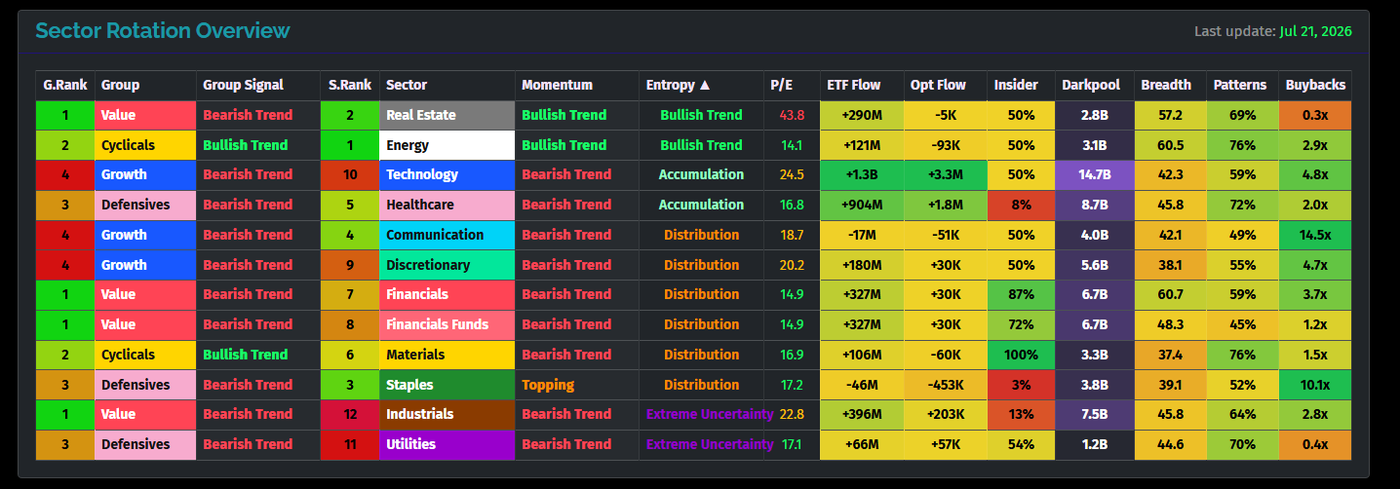
Sector regime shift in Technology - Accumulation
Very different from last week, Technology is in full Accumulation and shows bottoming patterns. All flows are in the green for Technology: ETF Flow Analysis, Option Flow Analysis and Dark Pool Flows, ahead of Q3 earnings.
The Technology ETF XLK saw 3 consecutive days of inflows, pushing the 20-day rolling flow index back into green territory.
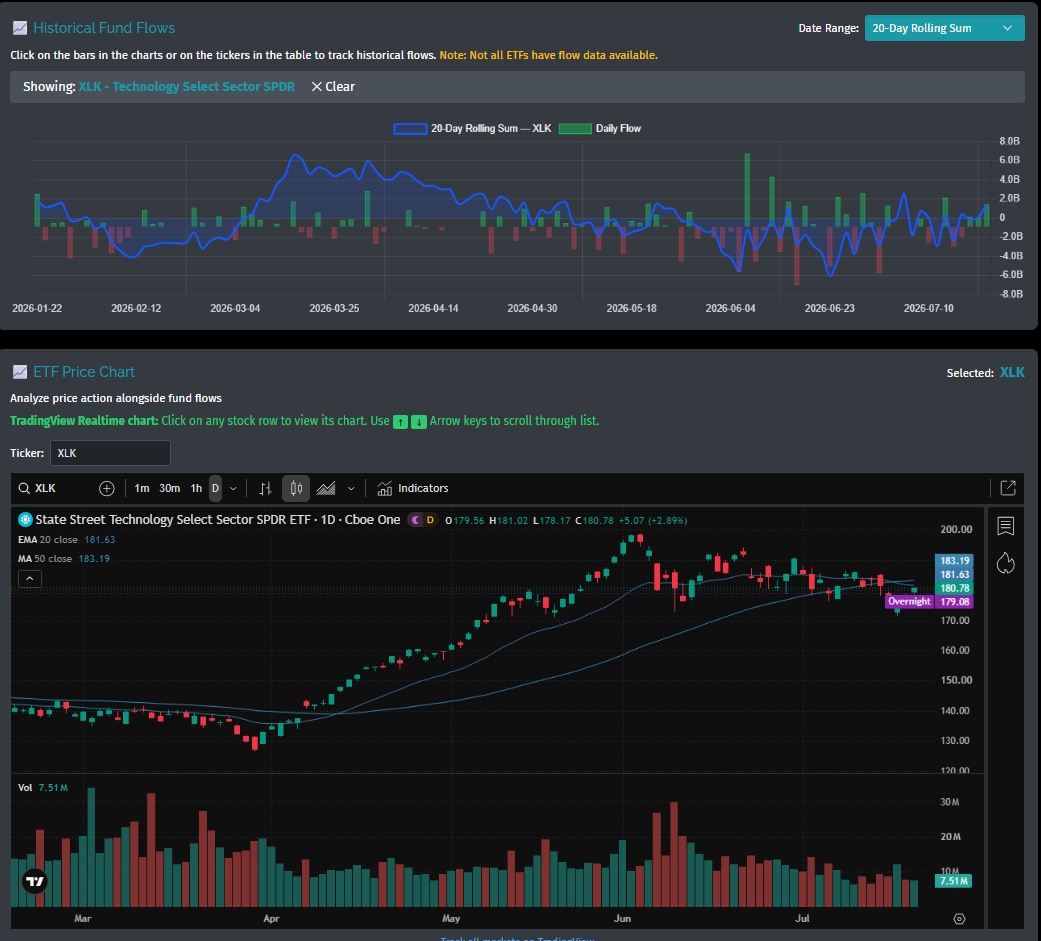
20-Day rolling ETF Flows into XLK (Technology sector ETF) and the price chart
Something similar was observed in March this year, pushing ETF flows to astronomical highs, which led to the massive April rally in Semiconductors. However, we are not at those levels yet.
The Option Flows have been pretty negative in May and June. Since July, we see almost only net positive flows, pushing the 20-day rolling Option Flow indicator to +108.2M.
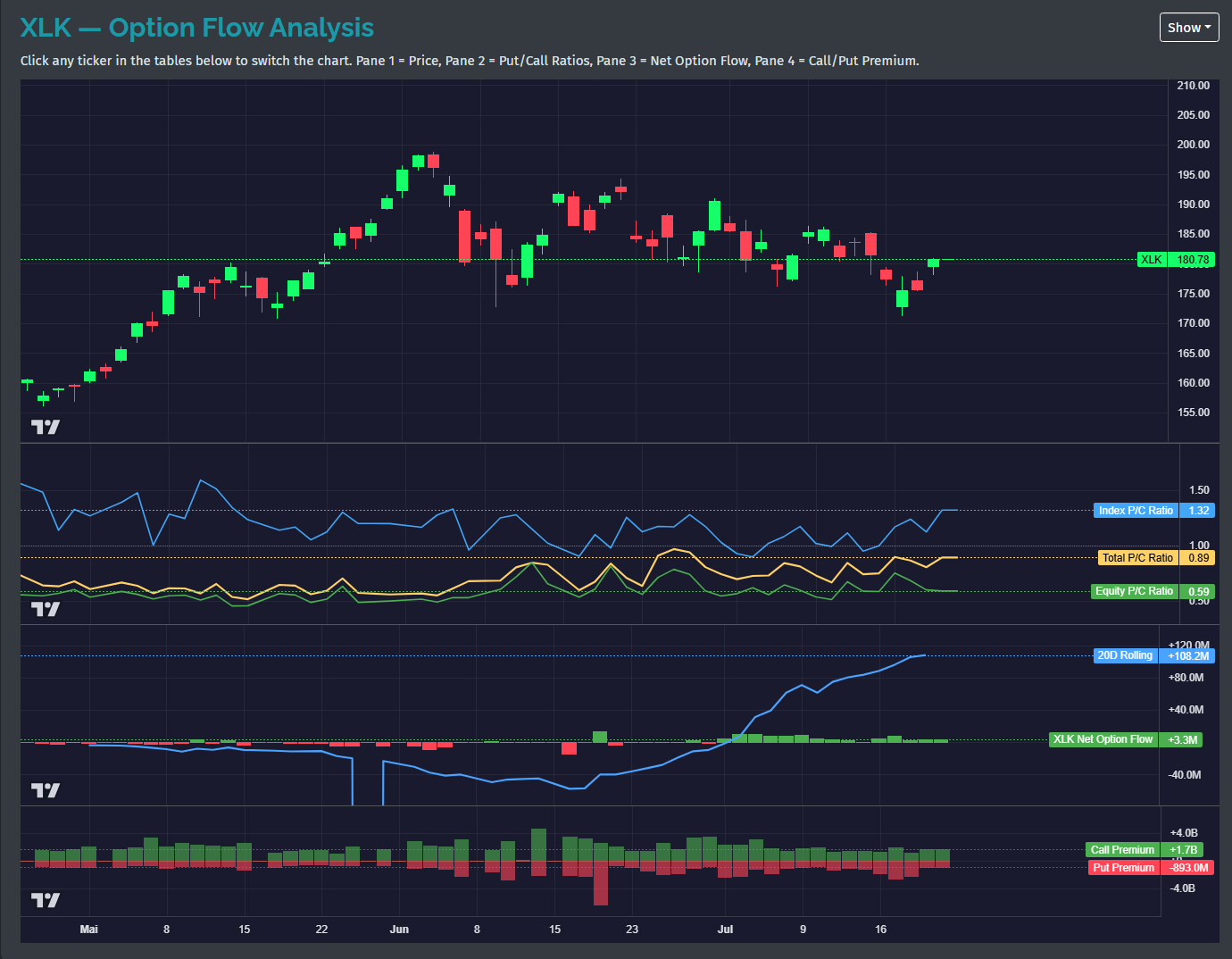
Option Flows into Technology
And last but not least, yesterday’s highest ETF dark pool volumes were detected in Semiconductor and Crypto ETFs:
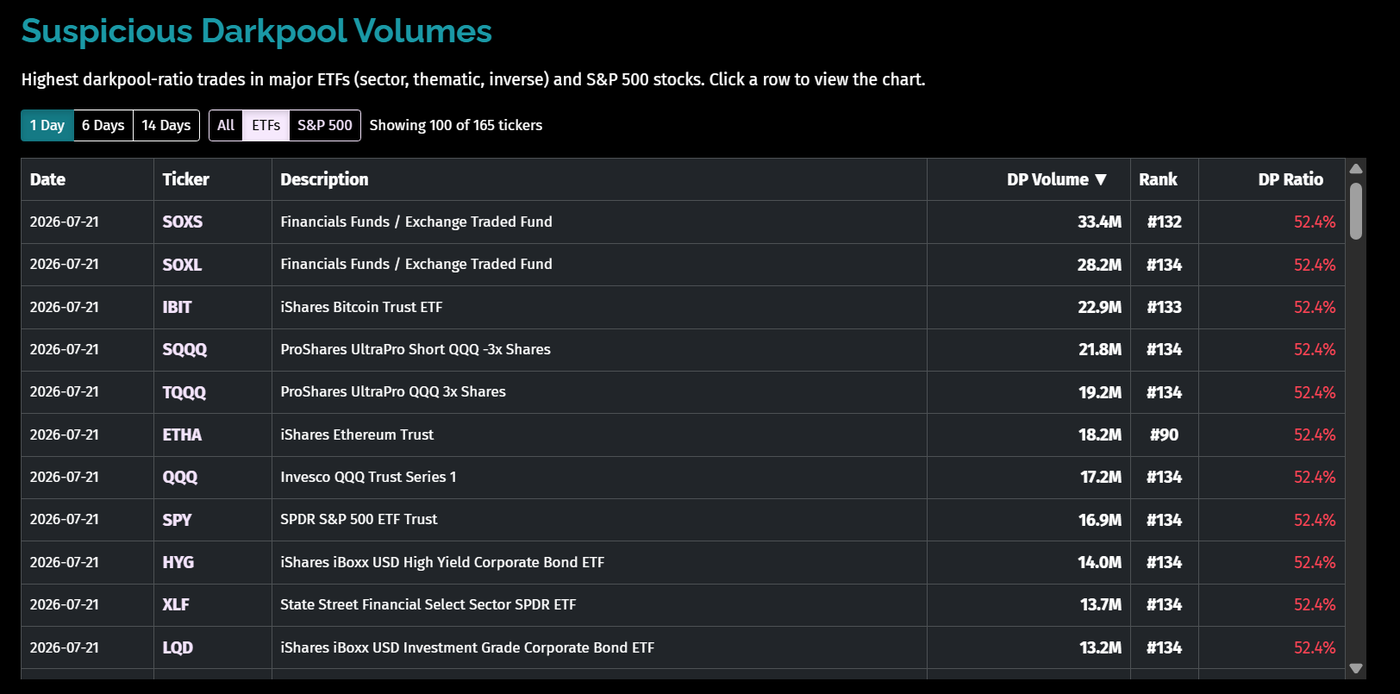
Yesterday's highest dark pool volumes into ETFs
This is the Semiconductor 3x leveraged Bull ETF, with a DP volume of 8.96M. That is approx. 17.4% of the total volume traded yesterday. Given the positive price action and the fact that it happened at the market lows, we assume that the dark pool trade was a buy.
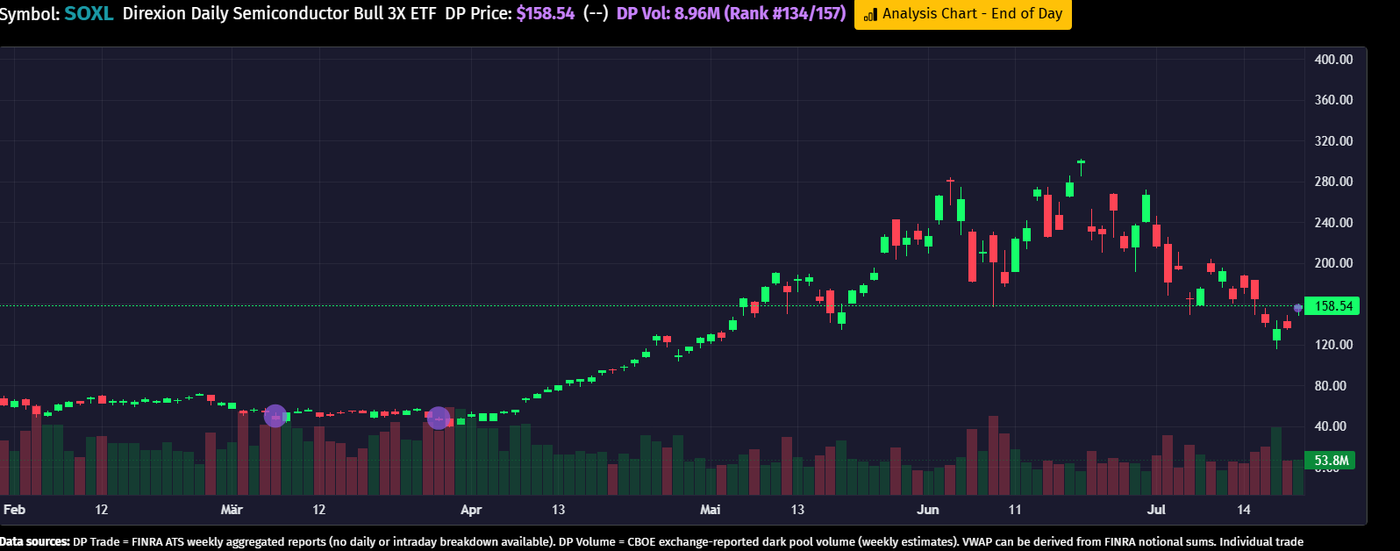
Yesterday's dark pool volume in SOXL (3x leveraged Bull Semiconductor ETF)
Notably, many Technology and Semiconductor stocks also showed DP trades, option inflows and formed bullish patterns. Micron is a good example with a bullish candle at the bottom of the upward trend channel, following a dark pool trade at the 860 support level. Worth mentioning that several politicians went long in the stock recently: (Josh Gottheimer, Gilbert Cisernos and Daniel Newhouse)
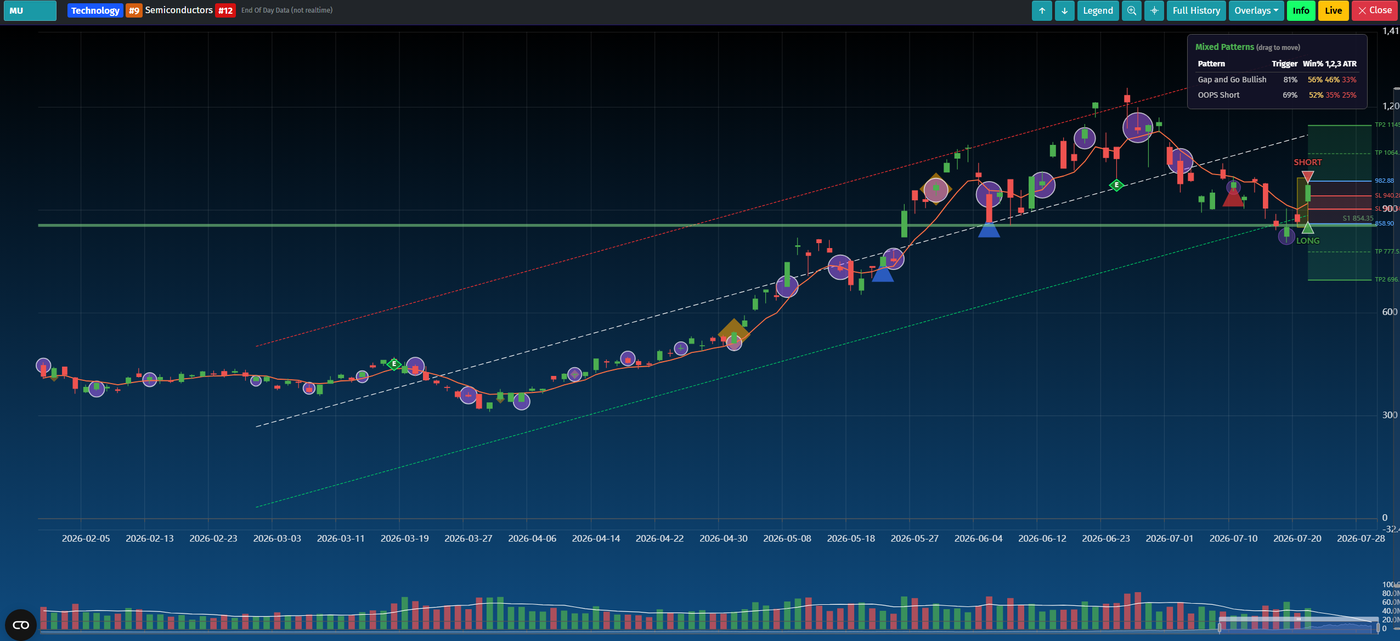
Analysis Chart of Micron (MU)
But what if … we have seen Peak-Earnings in Q2?
Higher oil prices are adding cost pressure to the AI data-center boom, primarily through construction, transportation, equipment and backup-power costs. However, the bigger constraints remain power availability, grid infrastructure and rising capital intensity. There is still little evidence of a broad slowdown in AI infrastructure spending, with hyperscaler capex expected to grow strongly in 2026. The key risk lies further ahead: UBS estimates hyperscaler capex growth at 76% in 2026, slowing to 25% in 2027 and just 6% in 2028. This suggests that peak capex growth may be approaching even if absolute spending continues to rise. Reuters
For Q3, the semiconductor outlook remains fundamentally bullish but increasingly vulnerable to expectations. Demand for AI accelerators, memory and networking infrastructure remains strong, suggesting that Q2 was more likely peak acceleration than peak earnings. The main risk is therefore not an immediate collapse in hardware orders, but a transition from hypergrowth toward normalization. With valuations already pricing in exceptional AI demand, even strong Q3 results could trigger valuation compression if forward guidance signals weaker capex momentum. Our Q3 view is therefore constructive on fundamentals but cautious on semiconductor equities: the AI infrastructure cycle remains intact, while the risk-reward is increasingly shifting from earnings growth toward the sustainability of future investment. Reuters | Reuters
Every $10 rise in oil prices corresponds to approx. -0.1 to -0.3% drop in GDP.
Especially data centers are dependent on cheap energy.
Our Commodities Screener reveals the current crude inventories to be at historical lows and a demand outlook that is rising steadily.
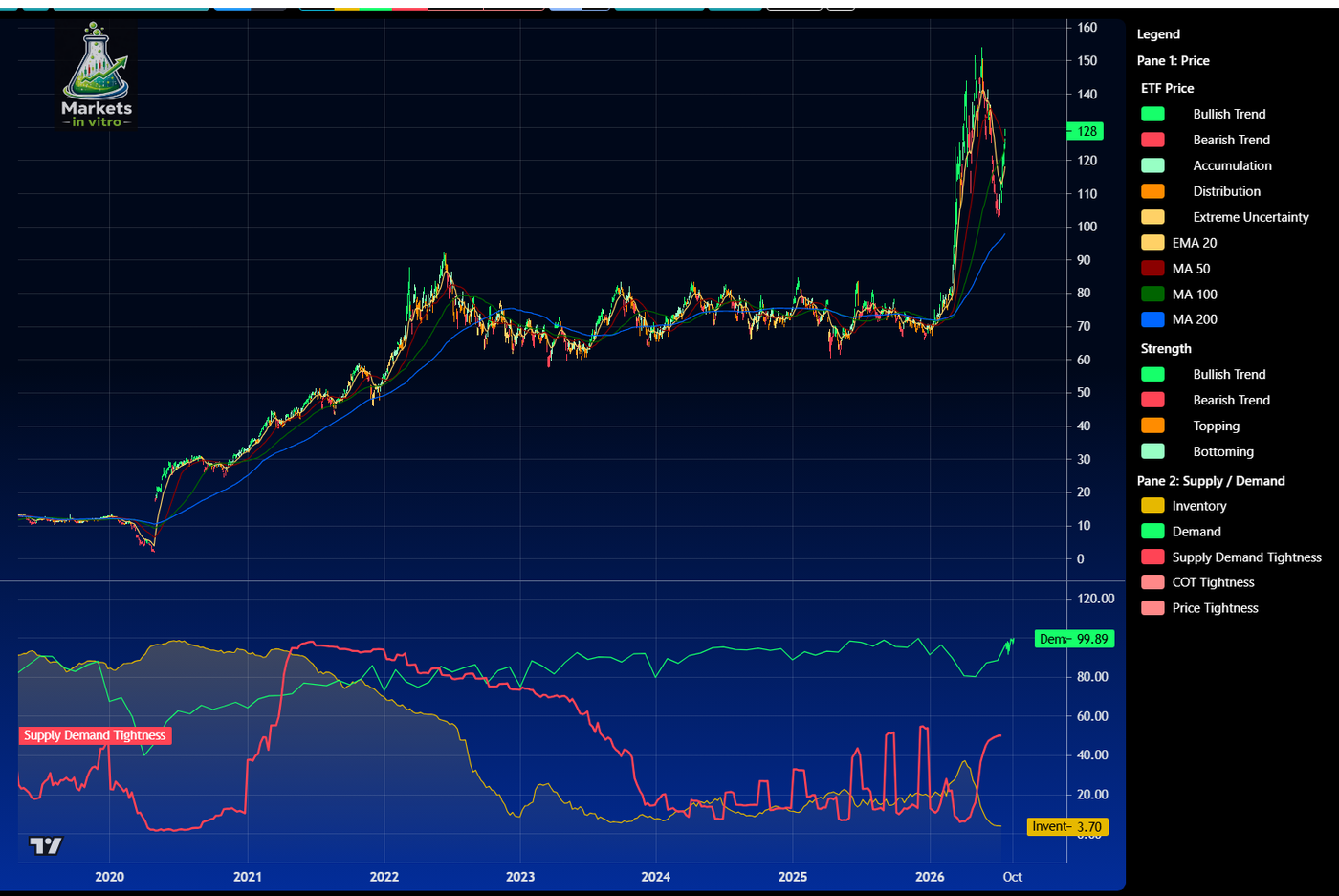
Crude oil inventories at extreme lows, with rising demand outlook
After the U.S. attacks on Iran in March of this year, the price for a barrel of crude rose from $65 to $150 (in the CL futures). Based mainly on hopes and tweets for a quick end to the war and a complete opening of the Strait of Hormuz, prices went down.
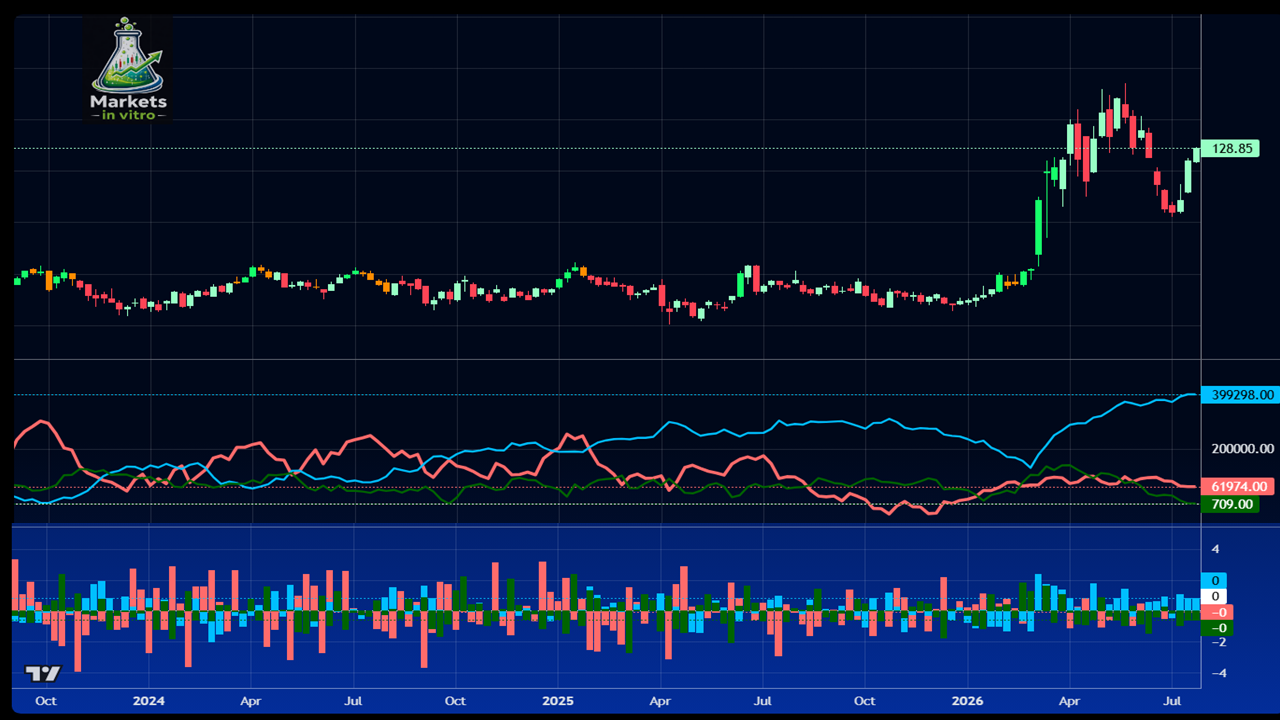
COT data of Crude Light futures
The COT Data reveals that none of the two main market contributors was responsible for the decline in crude oil prices, neither Producers nor Money Managers. A crowd of Other large Investors sold CL heavily. Now that prices are on the rise again, we at Markets in Vitro doubt that this potential Market Intervention is sustainable in the long run. In a functioning market, fundamentals will eventually bring price to its fair value, driven by supply and demand.
What most Retail-Traders miss
As retail traders become more and more a considerable weight in the stock market, they often focus only on buying pullbacks in Growth-Stocks. However, the bonds market is roughly 15% larger than the stocks market. Institutional money will choose the market which is expected to provide higher returns at lower risks. The 30-year U.S. Treasury yield just rose above 5.1%.
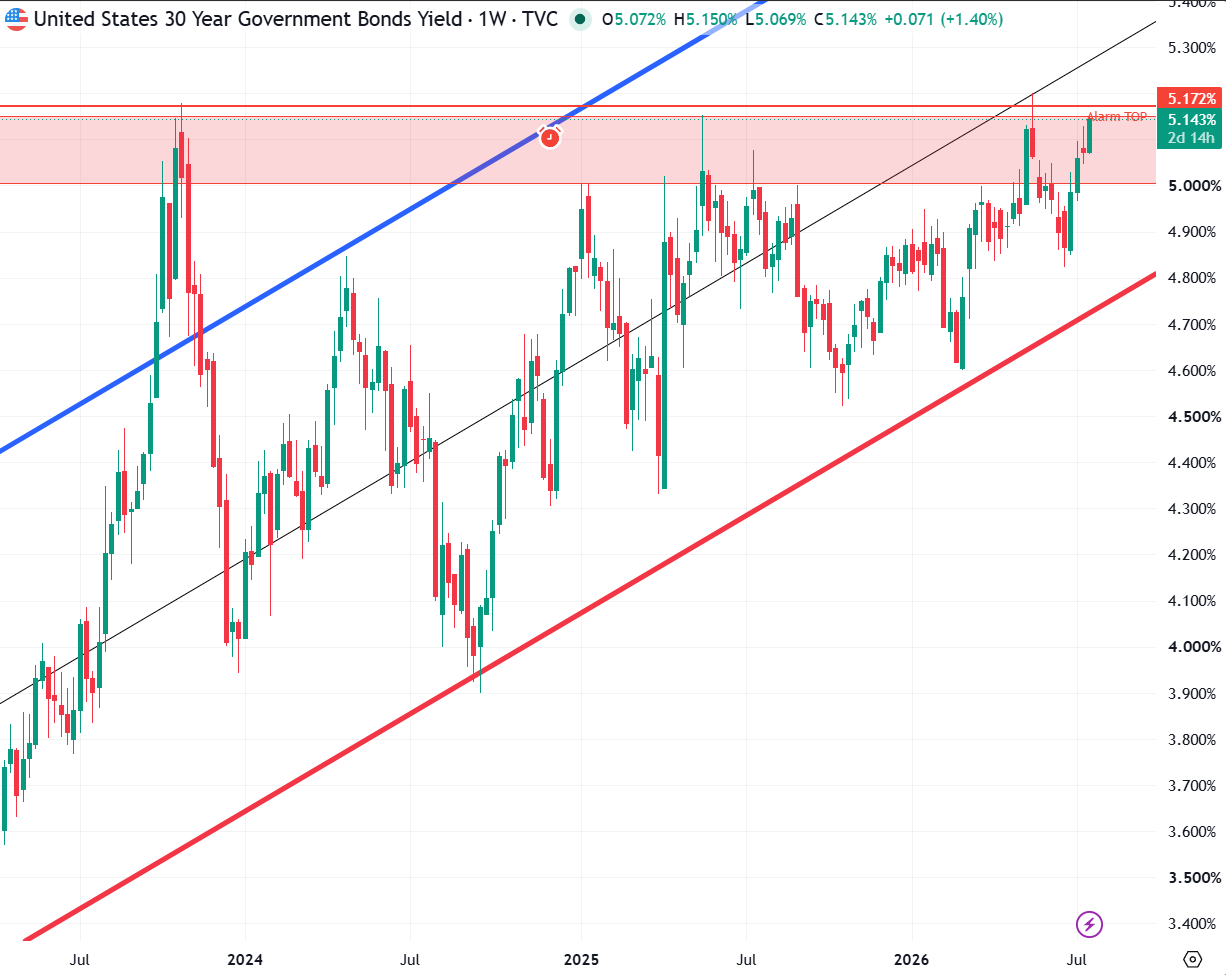
30-year U.S. Treasury yields
A more comprehensive picture provides the yield-curve evolution over the last year. While short-term yields have actually decreased, the long durations (10 years and more) are rising steadily.
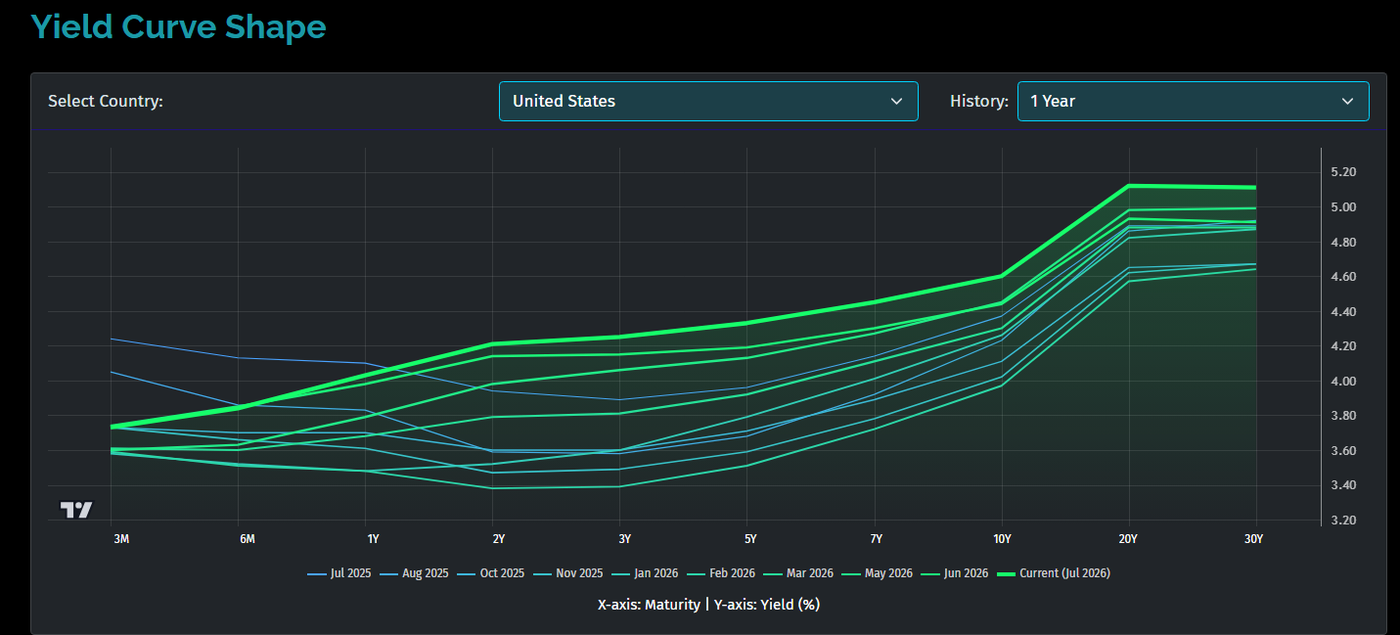
U.S. yield-curve evolution over 1 year
This so-called Bear Steepener typically marks periods with rising inflation, growing risks for growth and financials.
A decline in short-term Treasury yields combined with rising long-term yields creates a steeper yield curve and can become particularly problematic if driven by Fed rate cuts at the short end and persistent inflation, rising term premiums or fiscal concerns at the long end. For the U.S. government, lower short-term rates reduce near-term T-bill financing costs, while higher long-term yields make refinancing the growing federal debt increasingly expensive, potentially creating a negative feedback loop of higher interest expenses → larger deficits → more Treasury issuance → further upward pressure on yields. For consumers, Fed cuts may lower some short-term borrowing costs, but mortgage rates could remain elevated because they are more closely linked to long-term Treasury yields, leaving housing affordability under pressure. At the same time, elevated long-term corporate borrowing costs could constrain investment and economic growth. In this scenario, the Fed may cut rates without meaningfully easing broader financial conditions, potentially creating continued pressure on housing, corporate financing and equity valuations — particularly in high-duration growth and technology stocks.
The consequences could be dramatic, if yields should rise further or stay high for longer:
A sustained rise in the 10-Year U.S. Treasury yield above 5% — particularly toward 5.5–6% — could become a major tightening force for global financial markets, especially if driven by persistent inflation, rising term premiums or concerns about U.S. fiscal sustainability.
-
Equity Valuation Compression: Higher risk-free rates increase discount rates and reduce the present value of future earnings. High-duration growth, technology and AI stocks would be particularly vulnerable to P/E multiple compression.
-
Bonds Compete With Equities: Treasury yields above 5% offer investors attractive risk-free returns, potentially triggering capital rotation from equities into fixed income and raising the required equity risk premium.
-
Corporate Financing Costs Rise: Higher Treasury yields translate into higher borrowing and refinancing costs for corporations, potentially slowing investment and increasing default risks among highly leveraged companies.
-
AI & Data-Center CapEx Pressure: Higher financing costs could make the enormous AI infrastructure buildout more expensive. Earnings may continue to grow while valuations decline — creating a potential “Peak Valuation before Peak Earnings” scenario.
-
Housing & Consumer Weakness: Higher Treasury yields typically push mortgage and consumer borrowing rates higher, further reducing housing affordability and putting pressure on interest-sensitive consumer spending.
-
U.S. Fiscal Feedback Loop: Higher yields increase government interest expenses as debt is refinanced, potentially widening fiscal deficits and requiring additional Treasury issuance — creating further upward pressure on yields.
-
Stronger U.S. Dollar: Higher U.S. yields can attract global capital and strengthen the dollar, tightening global financial conditions and creating additional pressure on emerging markets and dollar-denominated borrowers.
-
Financial Stability Risk: Rapid Treasury yield spikes could stress leveraged positions in the Treasury and repo markets. The IMF has highlighted vulnerabilities associated with highly leveraged hedge fund Treasury basis trades.
Key Risk Scenario
Oil & Energy Prices ↑ → Inflation ↑ → Fed Cuts Delayed → Treasury Yields >5% → Financial Conditions Tighten → Equity Multiples ↓ → CapEx Financing Costs ↑ → Economic Growth ↓
Bottom Line: A 10-Year Treasury yield above 5% would not automatically trigger a market crisis. However, a sustained move toward 5.5–6% driven by inflation and rising term premiums could create significant pressure on equity valuations and credit markets. In such a scenario, AI and semiconductor earnings could remain fundamentally strong while stock prices decline due to multiple compression — making “Peak Valuation before Peak Earnings” a key market risk.
Sources: Federal Reserve – Monetary Policy Report | Federal Reserve – FOMC Minutes | IMF – Global Financial Stability Report
Outlook
While writing this article, we observed that the major U.S. indices just gave up yesterday’s gains, with the NQ making even a lower low. We interpret this as a major rotation of stocks from institutions to retail traders.