Market Analysis
The ES has reached the 6,500 SELL-zone as anticipated, following a one-time framing sequence of three consecutive sessions. Such moves into resistance often reverse quickly, making today’s price action critical. A consolidation around current levels without heavy selling would be interpreted as bullish and could invalidate the still-intact Ascending Triangle Pattern. The 38.2% Fibonacci retracement aligns with the 5,900–6,000 BUY-zone highlighted by the SP500 Indicator. Still, patterns remain only potential until confirmed, and that has not yet occurred.
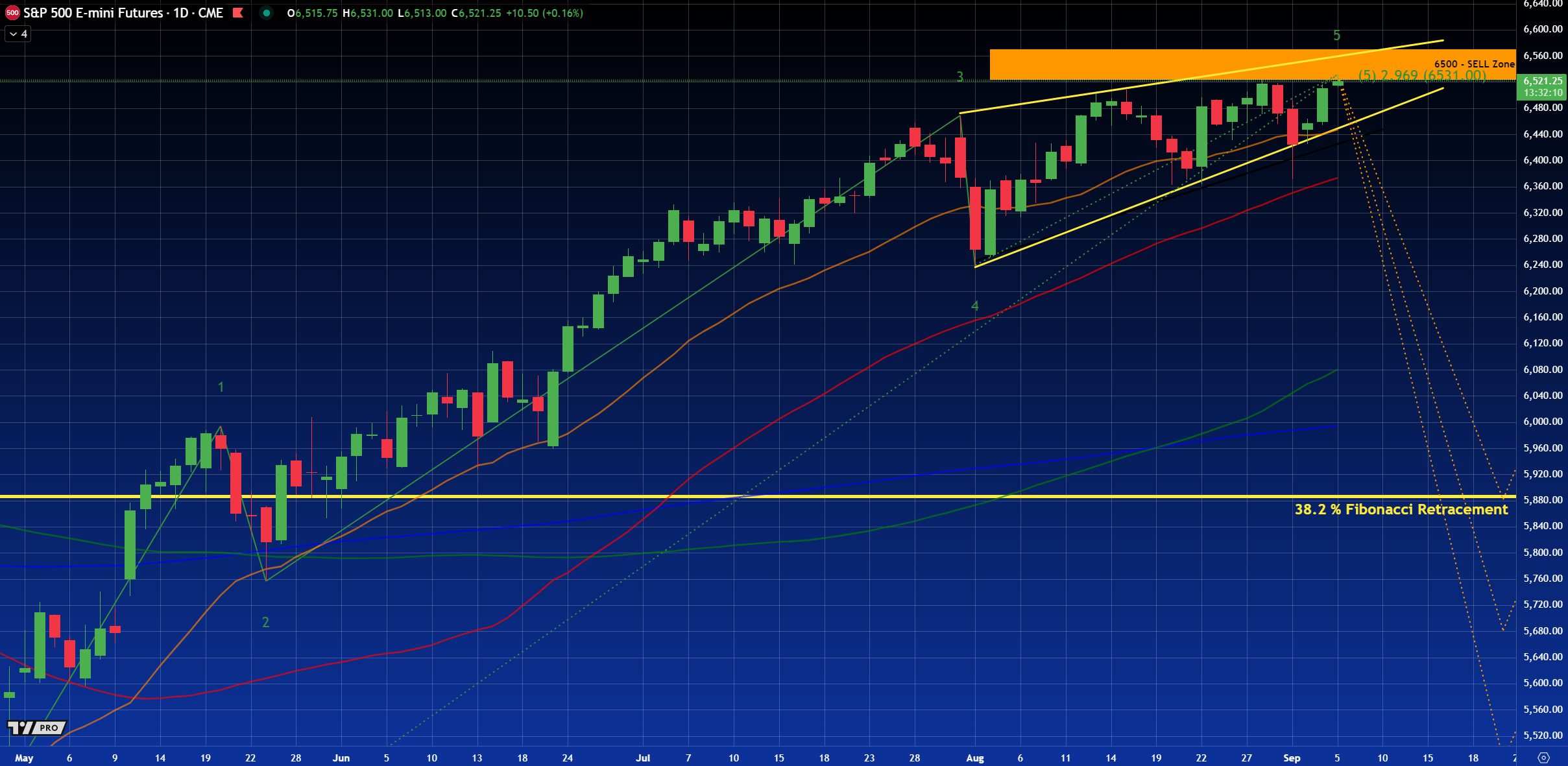
While this downside target may seem far away, September’s typical seasonal weakness could realistically drive such a correction.
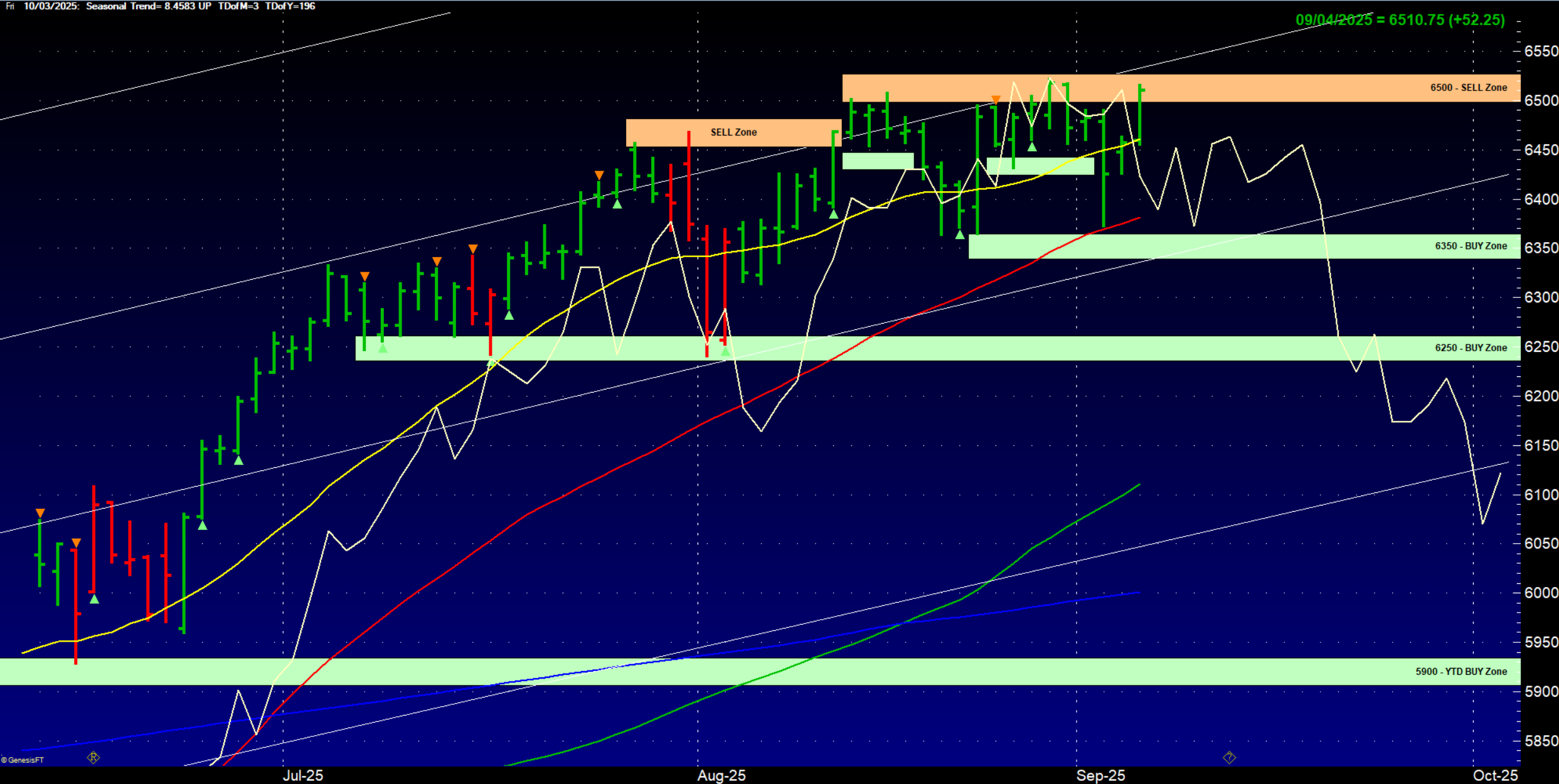
The SP500 Indicator is rebounding slightly but shows no signs of accumulation or a strong bullish impulse.
Background Story – Yields and the Bond Market
The MOVE Index, often described as the VIX for bonds, recently spiked after months of steady decline since April. The break of this downtrend signals rising risk in the Treasury market.
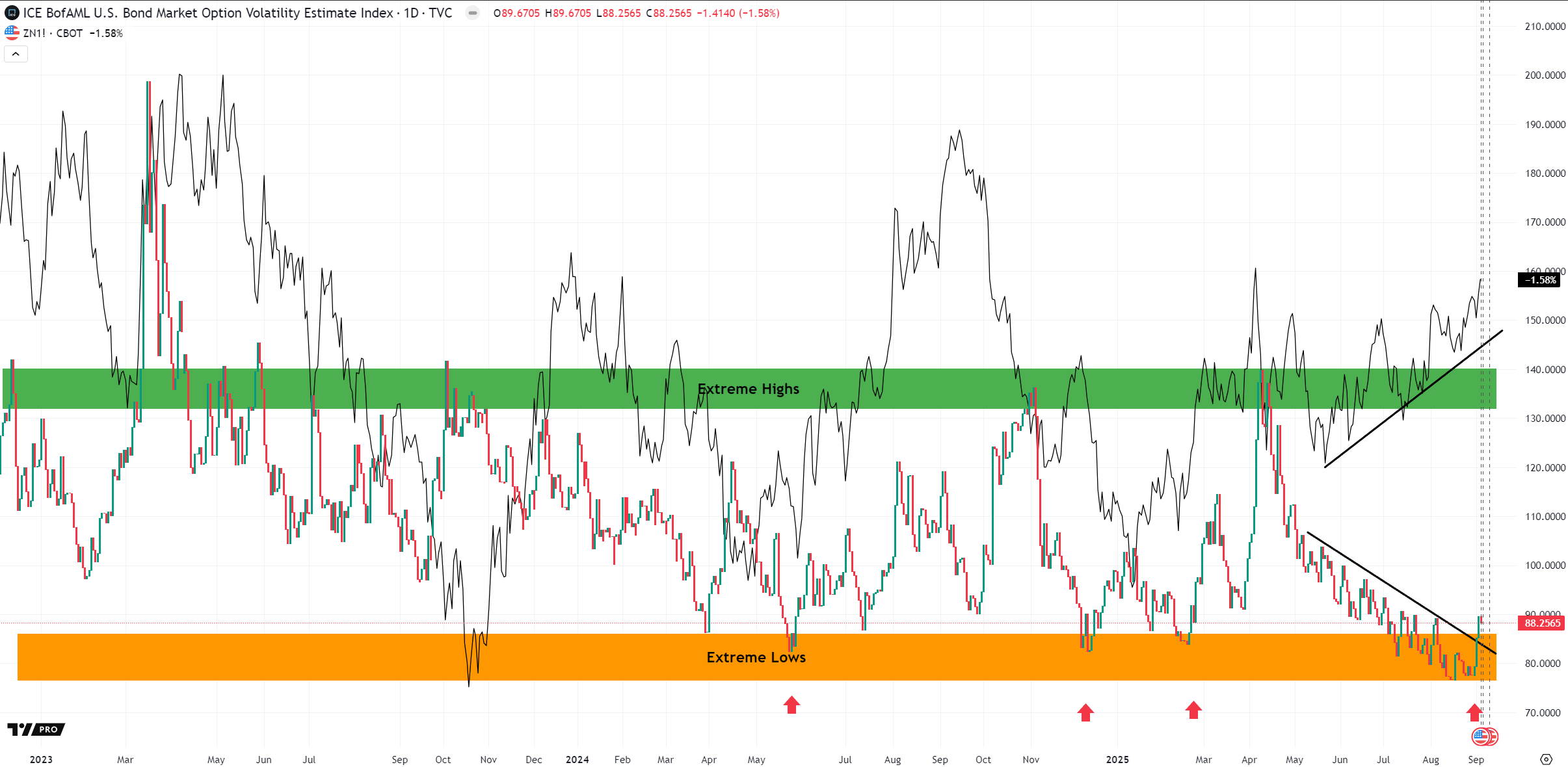
In 2025, the U.S. bond market has been shaped by a mix of shocks and calm. April’s tariff announcements triggered a sharp sell-off across assets and briefly rattled Treasuries. Stability returned after the swift reversal of tariffs and reassurance on long-term issuance. Since then, Treasury Secretary Bessent’s messaging, demand for short-term issuance, and reliance on tariff revenues as a fiscal cushion have supported confidence in Treasuries. By late summer, U.S. yields diverged from global peers—slipping slightly while others rose—underscoring Treasuries’ safe-haven role FT Barron’s.
The MOVE Index’s steady decline through summer reflected fiscal clarity after Trump’s “One Big Beautiful Bill,” consensus on the inflation outlook, and solid growth that reduced macro uncertainty. A steepening yield curve also supported financial stability by boosting bank profitability. Together with systematic volatility-selling, these dynamics suppressed swings in yields, leaving Treasuries unusually calm FT Reuters.
Short-Term Treasury Issuance: Shifting Risks
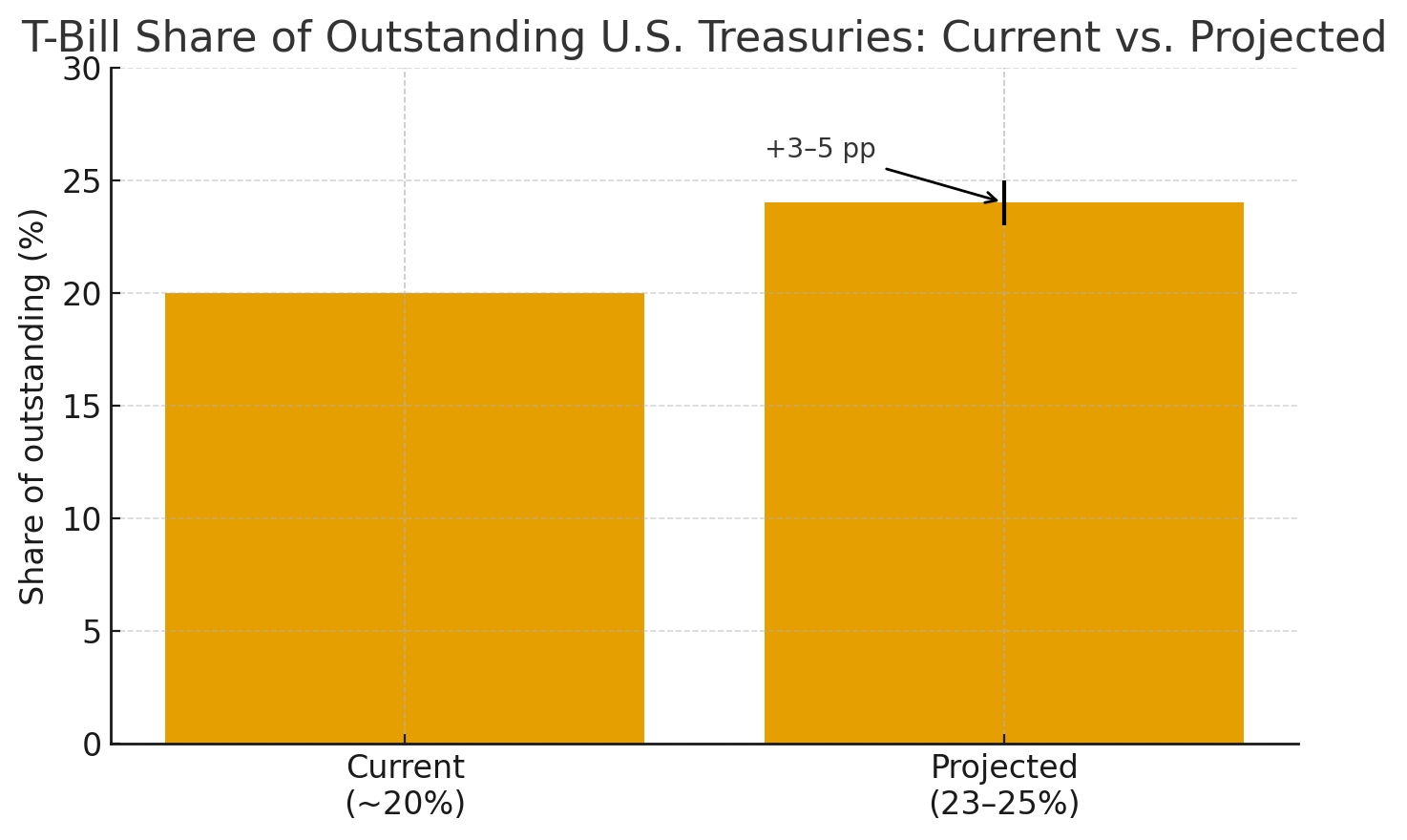
Analysts expect the share of T-Bills in total debt to rise from 20% to 23–25%, a jump of +3–5 percentage points.
Key Consequences
- Higher term premium: Stress periods could add up to 95 bps in yield pressure.
- Money-market strain: More bills could stress repo markets and dealer balance sheets.
- Policy side-effects: Heavy front-end issuance weakens Fed QT, acting like “stealth QE.”
- Liquidity & volatility: Market depth could thin and bid-ask spreads widen.
Sources: T. Rowe Price, State Street, Financial Times.
⚠️ Bottom Line
A bill-heavy strategy gives the Treasury flexibility and short-term funding relief. But it creates medium-term vulnerabilities:
- Rising refinancing risk as trillions must roll over every few weeks.
- Greater sensitivity to shocks in repo and funding markets.
- Potential for volatility spikes if inflation or Fed expectations shift.
- Weaker QT impact, effectively easing liquidity conditions.
- Long-term credibility concerns if front-end dependence persists.
In short, T-Bill reliance buys time but adds systemic fragility: the U.S. becomes more exposed to rate shocks and liquidity stress, leaving both policy and markets less resilient.
Background Story 2: Labor Market Weakness
Labor market data highlight renewed fragility. July saw just 73,000 new jobs, with prior months revised sharply lower: May cut from 144K to 19K and June from 147K to 14K—erasing 258K jobs. The three-month average is now only 35K, the weakest run since before the pandemic.
(Sources: Axios; Reuters; Washington Post)
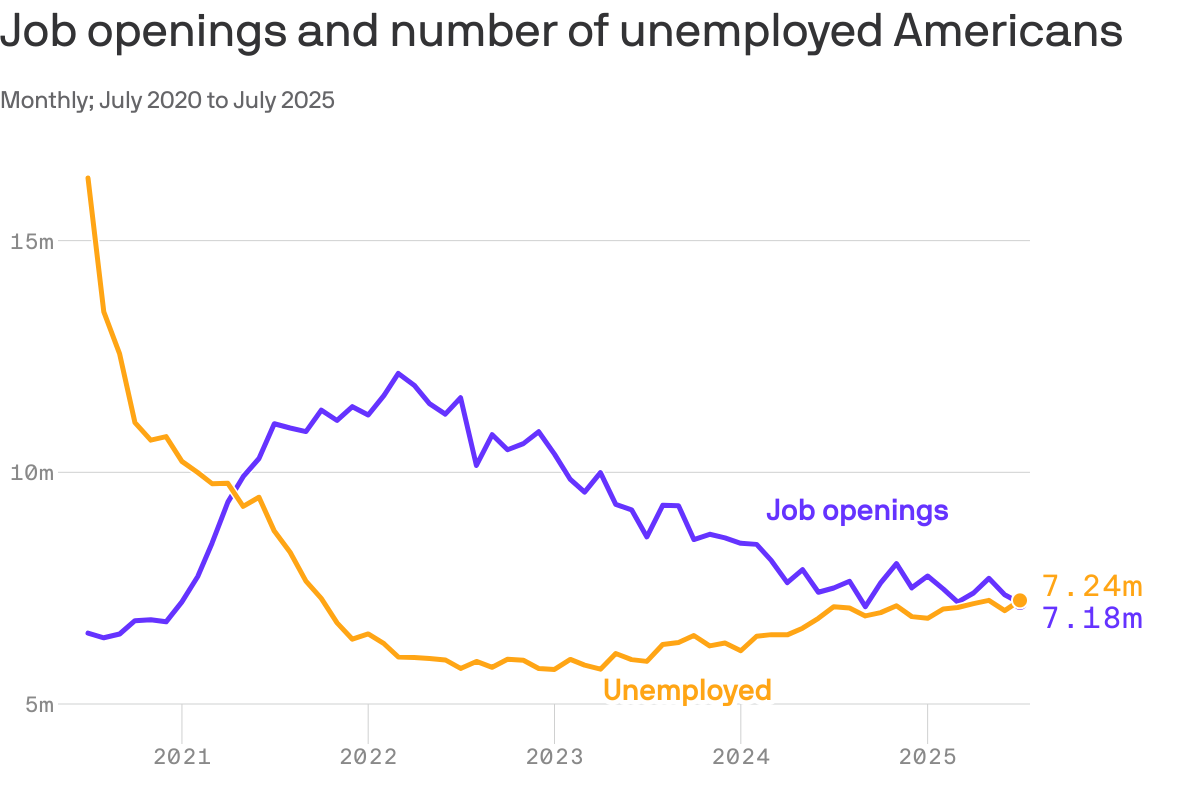
At the same time, job openings fell by 176K to 7.18M, while the number of unemployed rose to 7.24M. For the first time in four years, jobseekers now outnumber available jobs, a clear sign of weakening demand for labor despite headline unemployment near historic lows.
(Sources: Axios; AP; Reuters)
Market Outlook – Focus on NFP (Sept 5, 2025)
Today’s NFP release (8:30 a.m. ET) is pivotal:
- Consensus: 75K jobs (vs. 73K in July).
- Estimates range: 70K–80K.
- Wages: +0.3% MoM.
- Unemployment: Expected to rise to 4.3%.
Markets are pricing a 25 bps Fed cut (99% odds). A moderate print would reinforce easing expectations.
Impact on ES Futures
- ES up 0.2% pre-market, near record highs.
- A stronger report (80K+) could spark short-term gains but soften rate-cut bets.
- A weak number would likely fuel a bullish rally, raising odds of a second cut later in 2025.
Bottom line: ES remains bullish into the release, but market direction today will hinge squarely on the NFP surprise.