Everyone is watching Jackson Hole for the next Fed rate move. But the real story has already happened: behind the scenes, the Fed has started tightening again.
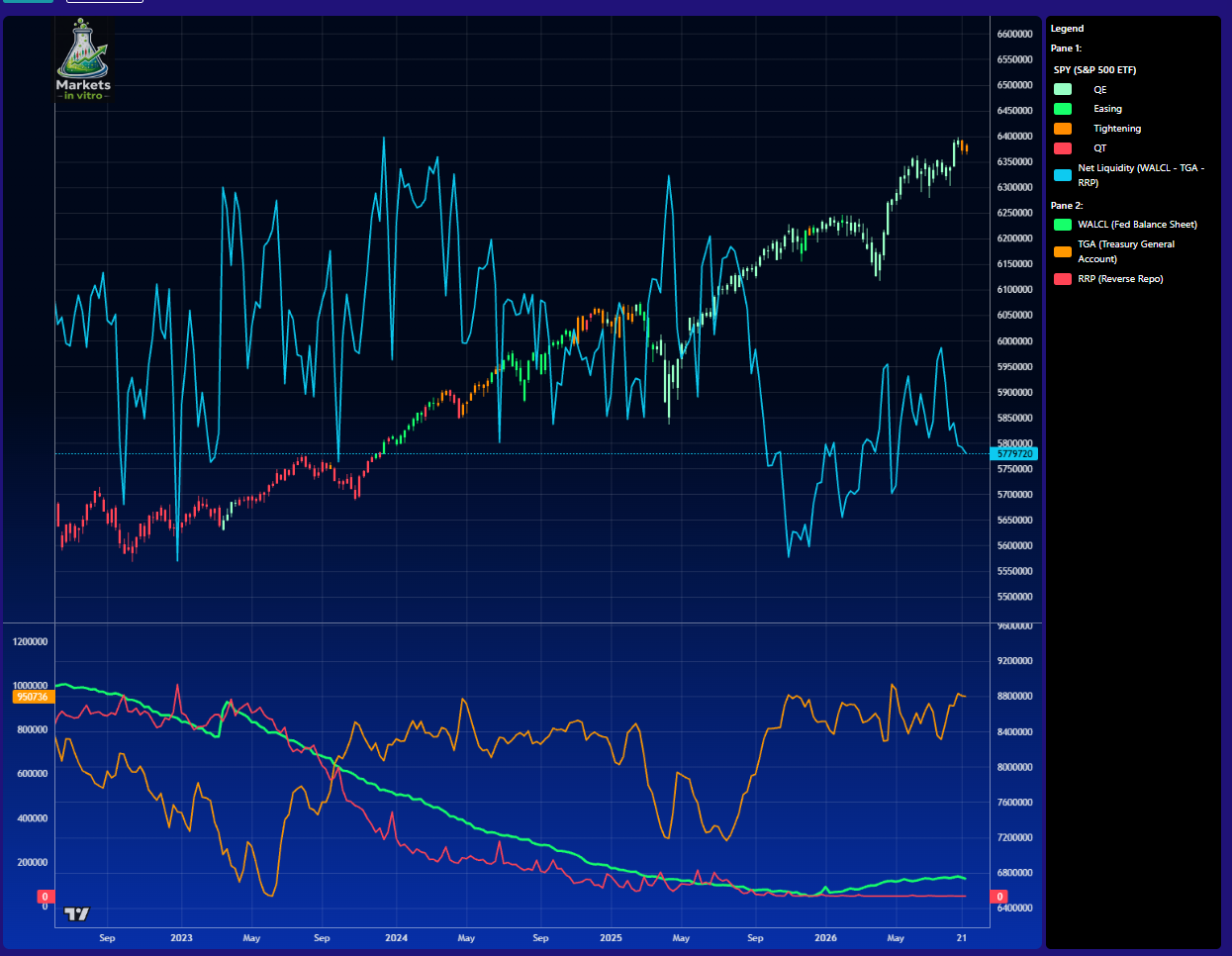
SPY, colored by the Fed regime Liquidity Fed balance sheet Treasury General Account Reverse Repo
A falling Fed balance sheet (WALCL) and rising TGA both drain liquidity from the financial system. That means fewer reserves, tighter financial conditions and a growing headwind for equities and other risk assets—unless another liquidity source offsets the drain.
About two weeks ago, the Markets in Vitro Fed model switched regime: from Quantitative Easing to Tightening. Since the beginning of 2026, the Fed balance sheet had been growing, supported by purchases of short-dated Treasuries to maintain adequate reserve levels. But that trend has now reversed: WALCL is falling while the Treasury General Account is rising, creating a double liquidity drain. While markets are focused on the next rate decision, under the surface, monetary liquidity has already started tightening.
Fed rates and Taylor est. rate
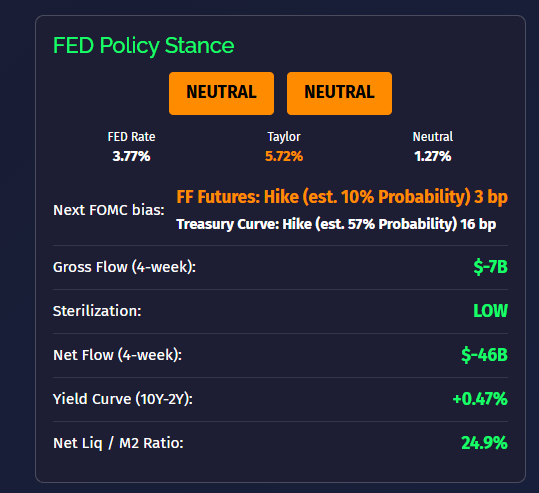
The current Fed Funds Rate stands at 3.77%, well below the 5.72% suggested by our Taylor Yield estimate, which incorporates inflation, economic activity and a 1.27% neutral real rate.
Fed yields and outlook
The neutral rate is the estimated real interest rate that neither stimulates nor restricts economic activity—the theoretical equilibrium rate consistent with an economy operating near its potential and stable inflation.
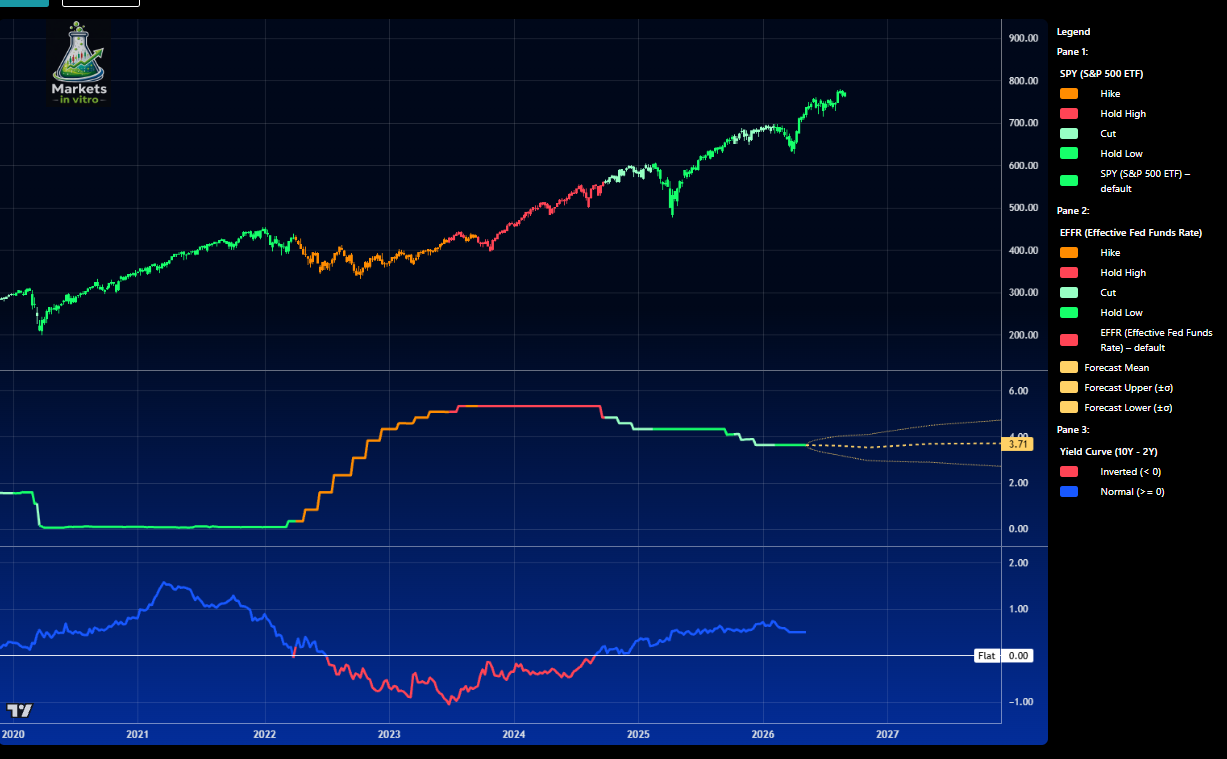
Yet markets remain far less hawkish: Fed Funds Futures price only about a 10% probability of a hike, equivalent to roughly +3 bp, while the Treasury curve implies a much higher 57% probability, or about +16 bp. This creates an unusually wide gap between the policy rate, economic fundamentals and market expectations—making today’s Jackson Hole message especially important for determining which side of that gap has to adjust.
Explore the full Fed liquidity framework, monetary-policy regimes, Taylor Yield estimates, neutral-rate models, Treasury liquidity dynamics and market signals on Markets in Vitro – Fed Liquidity Analysis, where all related indicators and models are brought together to track how changes in Fed policy and system liquidity may affect financial markets.