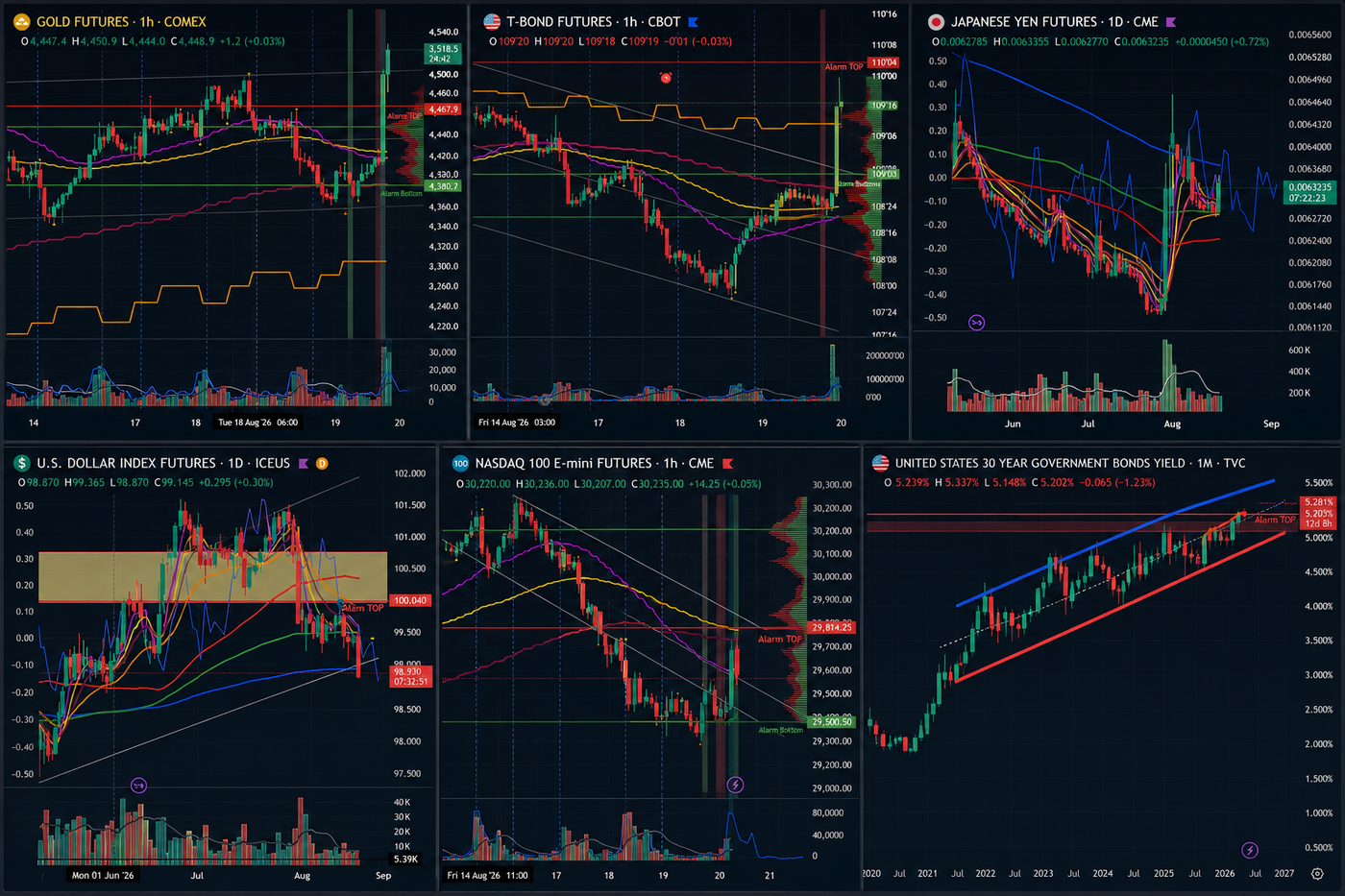
Markets reacted with a hefty cross-asset move after the U.S. Treasury announced a significant expansion of its buyback operations for longer-duration government debt. Long-dated Treasuries rallied alongside gold and the Japanese yen, while the U.S. dollar came under heavy pressure and equity indices oscillated between gains and losses. But beneath these volatile price moves lies a much bigger story: a rapidly growing U.S. refinancing burden, Treasury’s increasing reliance on short-term debt, rising Japanese yields, and the potential unwinding of one of the world’s largest carry trades. The question is whether these forces are merely colliding—or whether Treasury and Fed policy are increasingly working, quietly and without saying so out loud, to keep long-term U.S. yields under control.
The initial reactions of the markets after the US Treasury announcement to double long-term buybacks
The U.S. Treasury announced that it will increase buybacks of longer-duration Treasury bonds, particularly in the 10–20 year and 20–30 year sectors.
But why would the world’s largest debtor suddenly start buying back its own debt? Purely out of fiscal prudence, no doubt.
Long-term Treasury yields are the foundation for borrowing costs across the U.S. economy. When they rise too far, financial conditions tighten:
Eventually, high yields can choke economic growth. Reducing the amount of long-duration debt available to the market can therefore provide some relief to the long end of the yield curve. Convenient, given who is doing the reducing.
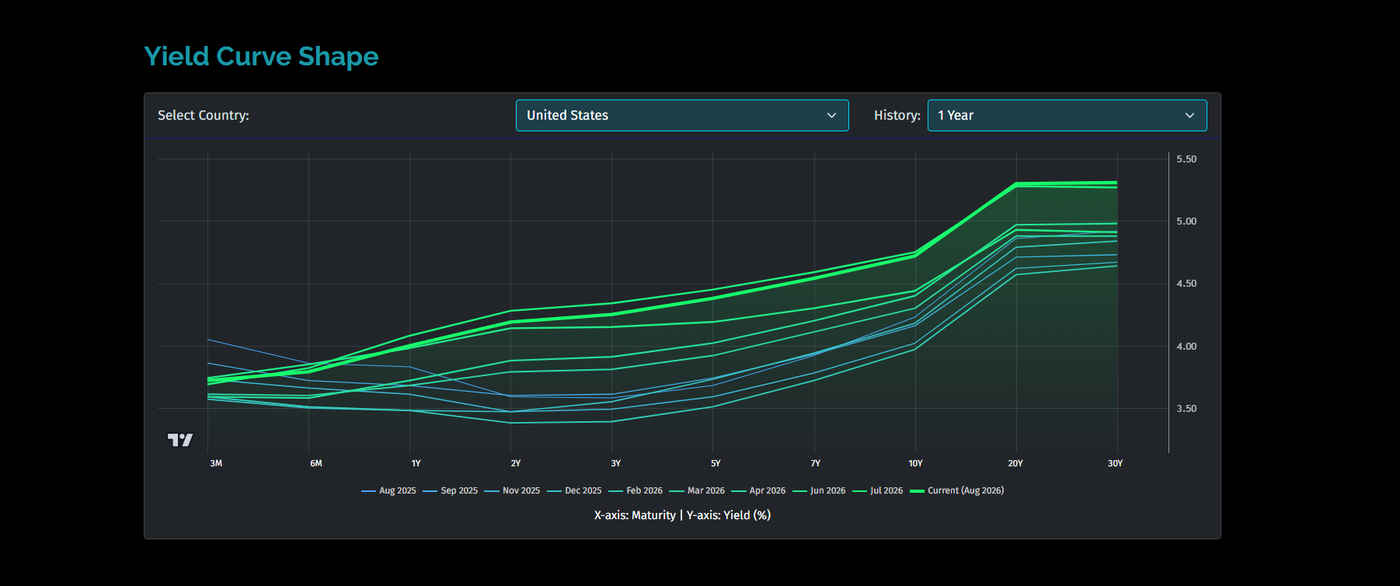
US Yield curve evolution in the last 12 months. Long.Term yields are rising, while the short-term is falling.
Markets in Vitro Yield Curve Analysis
And this is the global distribution of yild curve regimes.
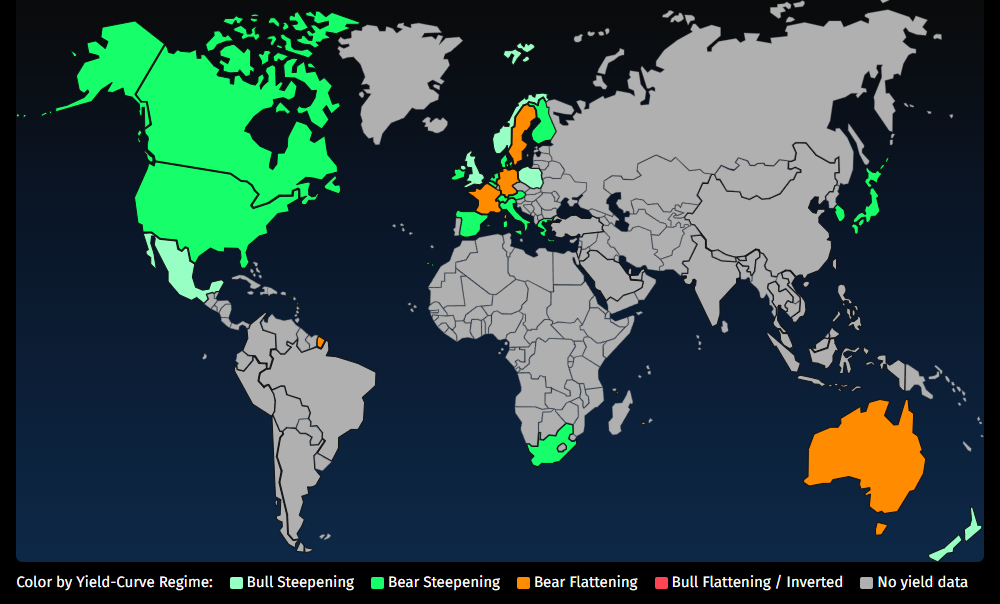
Global yield curve regimes
Here comes the interesting part. Treasury cannot print money. It has to obtain cash through taxes or borrowing. At the same time, the U.S. government is running enormous deficits and constantly refinancing maturing debt. So Treasury is effectively doing two things simultaneously: Issuing new debt and buying back existing debt.
The crucial difference is the maturity. Treasury has relied heavily on short-duration Treasury Bills to finance deficits and refinancing needs. Meanwhile, it is now increasing buybacks further out on the curve.
Conceptually: Issue short → Buy long The debt does not disappear. Its duration changes.
Treasury Absorbs long-duration debt, Central bank Offsets short-term supply.
This is where things get really interesting. The Federal Reserve is conducting Reserve Management Purchases. And what is the Fed primarily buying? Treasury Bills. The Fed purchases Bills from the secondary market and pays for them by creating central-bank reserves. Purely a technical matter of reserve management, of course. Nothing to see here.
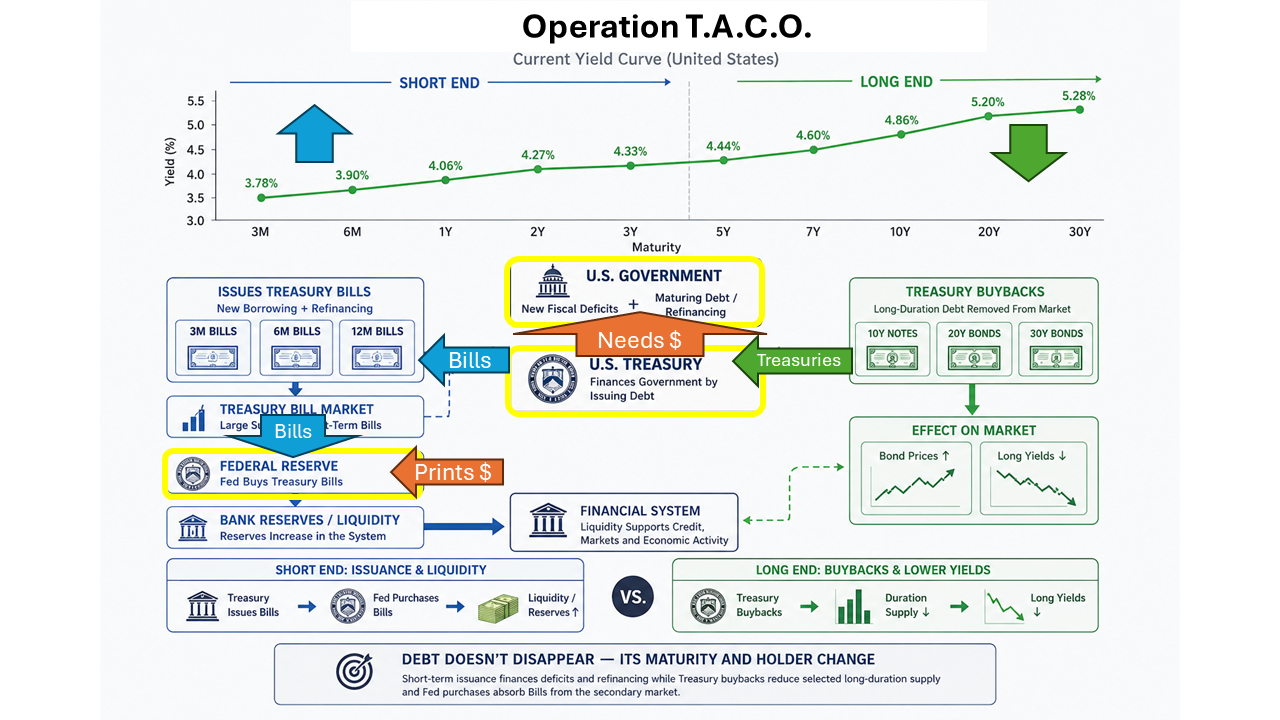
Operation TACO: Treasury buys back long-duration debt while the Fed absorbs short-term Bills — reshaping the yield curve without calling it QE, Twist, or YCC.
Technically, no. Traditional QE involves the Fed creating reserves and buying long-duration Treasuries or MBS specifically to lower long-term borrowing costs and ease financial conditions. Today’s Fed purchases primarily target Bills and are officially designed to maintain sufficient banking-system reserves. But there is an important similarity:
The Fed is expanding its Treasury holdings and creating reserves. The plumbing resembles QE. The maturity and official objective are different. The label, mercifully, is also different — which is the entire point.
Again, not technically. Classic Operation Twist looked like this: Fed sells short-term Treasuries → Fed buys long-term Treasuries
Today the operations are split between two institutions: Treasury → buys longer-duration bonds while Fed → buys Treasury Bills It is therefore not Operation Twist. But viewed from the consolidated government balance sheet, there is certainly a resemblance.
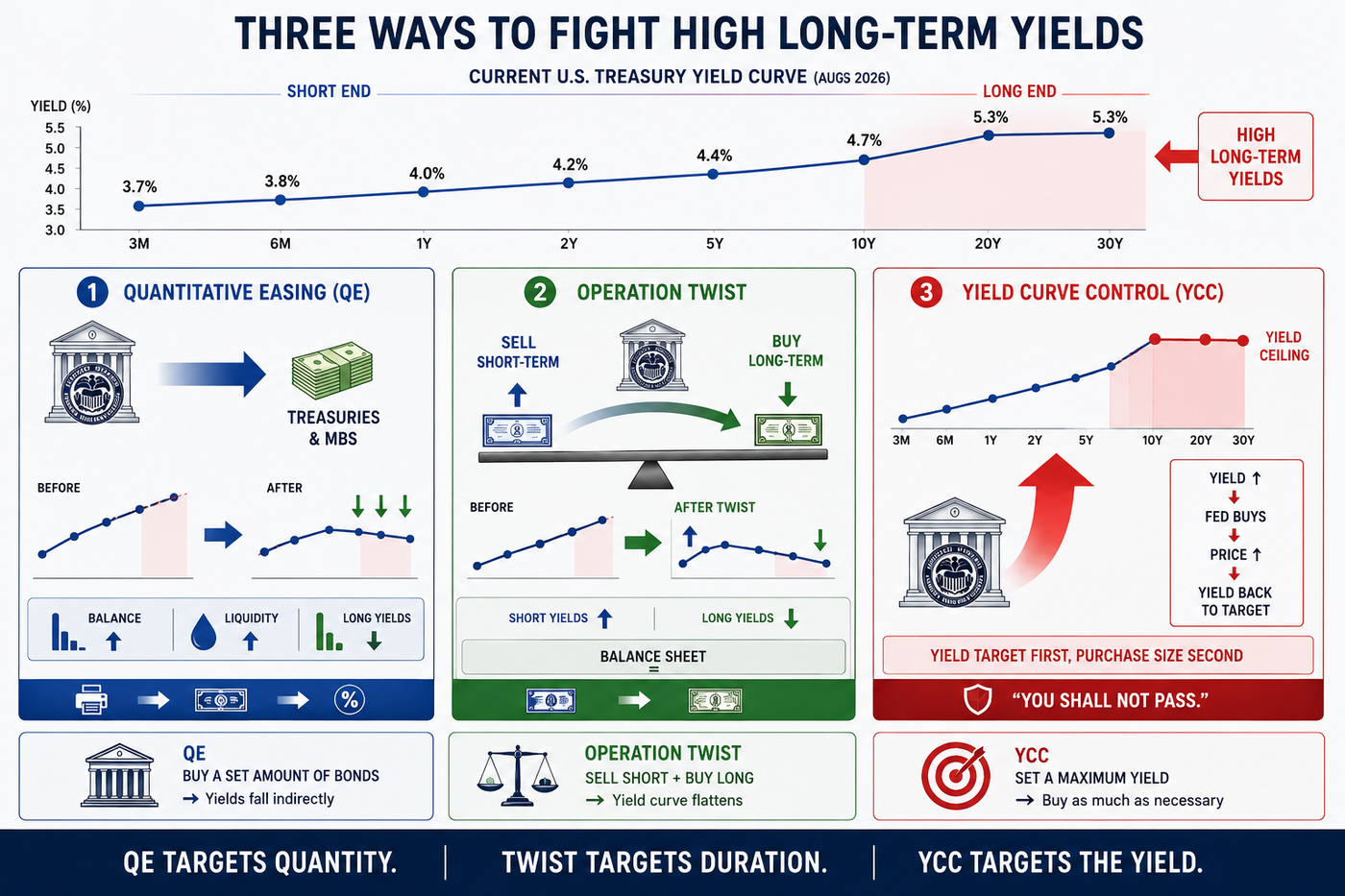
Quantitative Easing, Operation Twist and Yield Curve Control explained
Not yet.
True Yield Curve Control would mean the Fed explicitly targets a long-term yield and commits to buying whatever amount of bonds is necessary to defend it.
Today there is:
So this is not YCC, but could be called Soft Yield Curve Control — all the benefits of intervention, none of the awkward press conferences.
The U.S. government faces a difficult equation: Record debt + massive refinancing + high long-term yields Issuing enormous amounts of long-duration debt could push yields even higher. Instead, Treasury can rely more heavily on the highly liquid short end while buying back selected longer-duration securities. And the Fed is simultaneously absorbing Bills and supplying reserves.
There is one major problem: short-term debt matures quickly. Bills issued today must be refinanced in: 3 months. 6 months. 12 months. Then they have to be rolled again.
And again.
And again.
The strategy therefore trades duration risk today for refinancing risk tomorrow. If the Fed cuts rates, Treasury can refinance those Bills more cheaply. If inflation stays high and short rates remain elevated, the refinancing burden becomes increasingly expensive. That may ultimately be the bigger story.
A recession pushes inflation and interest rates lower. The Fed cuts rates, allowing Treasury to roll its massive amount of short-term debt at progressively cheaper rates.
Recession → Fed Cuts → Refinancing Costs ↓ → Fiscal Pressure ↓
In this scenario, issuing Bills instead of locking in today’s high long-term rates could prove to be a smart move.
Persistent or accelerating inflation forces the Fed to keep rates high—or raise them further. Maturing Bills must then be refinanced at higher rates.
Inflation → Rates ↑ → Refinancing Costs ↑ → Interest Expense ↑ → Deficit ↑ → More Debt
This is the dangerous scenario: the refinancing wall turns into a self-reinforcing debt cycle. The strategy therefore contains a massive implicit bet:
Future short-term rates will be lower, not higher. A bet placed, conveniently, by the same institution that sets those rates.
For consumers, neither scenario is particularly attractive. A recession would allow the Fed to cut rates and make mortgages and loans cheaper, but only because economic activity is deteriorating—bringing weaker wage growth, job losses and falling asset prices. Persistent inflation is arguably worse: interest rates remain high, mortgages and consumer credit stay expensive, purchasing power continues to erode, and rising government interest expenses put additional pressure on public finances. One scenario attacks income and employment; the other attacks purchasing power and borrowing costs.
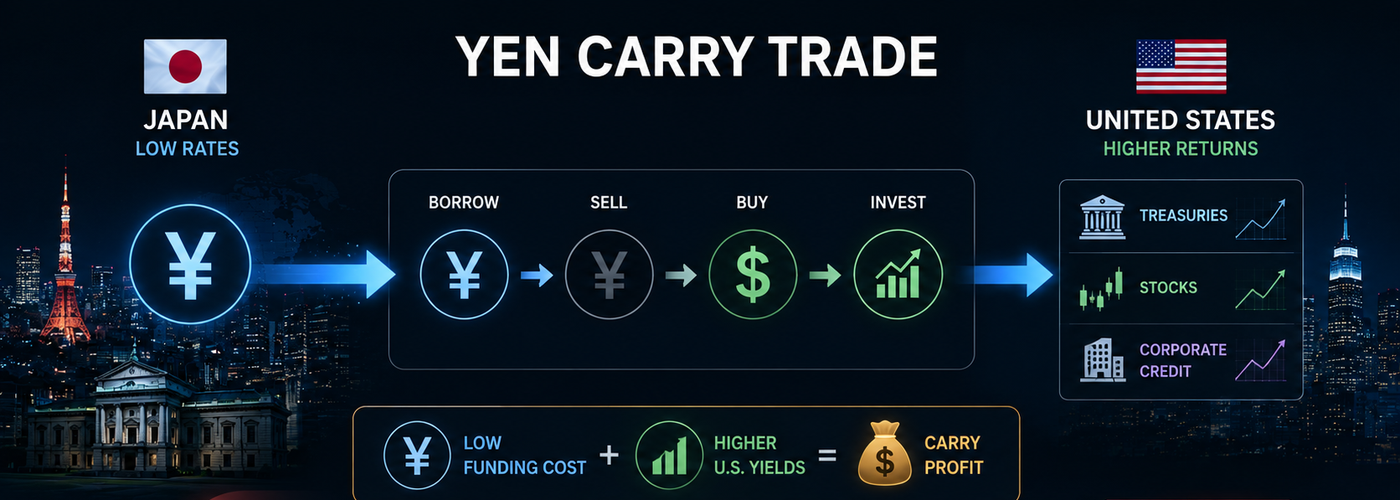
The Yen Carry Trade exploits Japan's low interest rates: investors borrow cheaply in yen, convert the funds into dollars, and invest in higher-yielding U.S. assets such as Treasuries, stocks and corporate credit. The trade becomes vulnerable when Japanese yields rise or the yen strengthens, potentially forcing investors to unwind positions and repatriate capital to Japan.
For decades, Japan provided the world with extremely cheap capital. Investors could borrow in low-yielding yen and invest in higher-yielding U.S. Treasuries and other global assets. But rising Japanese yields are changing that equation. As JGB yields become more attractive and the yen strengthens, the incentive to hold U.S. assets declines and leveraged carry trades become increasingly painful. This creates the risk of capital returning to Japan and Treasury positions being unwound—just when the U.S. government needs enormous demand to finance record debt and its refinancing wall.
The dangerous chain is simple:
Japanese Yields ↑ + Yen ↑ → Carry Trade Unwind → Capital Repatriation → Treasury Demand ↓ → U.S. Long-Term Yields ↑
That creates another reason why keeping the long end of the U.S. yield curve under control is becoming increasingly important.
Scenario 1 — Treasury Repatriation:
Rising Japanese yields and a stronger yen make domestic assets more attractive. Japanese investors sell U.S. Treasuries, convert dollars back into yen and bring capital home. Treasury prices fall and U.S. long-term yields rise—exactly when the U.S. needs massive demand for its debt.
Scenario 2 — Global Risk-Off:
A rapidly strengthening yen forces leveraged investors to unwind carry trades across equities, credit and other risk assets. Markets sell off and investors flee into safe-haven U.S. Treasuries. In this case, stocks fall but Treasury prices rise and U.S. yields decline.