Market Analysis
A fresh accumulation pattern has surfaced, hinting that markets may be setting up for a short-term reversal. Yet the looming Fed rate decision casts a long shadow over any durable trend change. The prior accumulation attempt failed, and while the 6600 BUY zone held perfectly, a decisive trend reversal would usually require a clean retest of the Daily MA100 before downward momentum can be declared exhausted.
Conclusion
Some investors appear to be quietly positioning for a year-end rally — and a potential Fed rate cut could serve as the needed spark. A short-term bullish bounce looks likely, but the broader downtrend is very much alive.
The Looming Fed Rate-Cut Decision
The Federal Reserve is inching toward its next major policy call, and policymakers are anything but relaxed. Inflation remains stubbornly above target, and the recent government shutdown disrupted critical data flows — leaving the Fed partially “flying blind.”
Source: Washington Post
At the same time, labour-market cooling and deteriorating growth indicators would normally argue for easing. Yet several officials openly oppose a December cut, citing unreliable data and persistent inflation uncertainty.
Source: Investopedia
Market-implied probabilities currently show only a 32% chance of a December rate cut.
Source: CME FedWatch Tool
Market Scenarios
Bullish scenario:
The Fed cuts in December. Liquidity expectations ease, equities extend their rebound, credit spreads compress, and risk assets rip higher.
Bearish scenario:
The Fed skips. Sticky inflation + missing data = higher-for-longer. Valuations contract, volatility spikes, and a risk-off rotation strengthens across credit, real estate, and cyclicals.
The Great AI Illusion – NVIDIA’s Tightrope Act Above the Hype
NVIDIA has once again delivered blockbuster numbers: \$46.7 billion in revenue, up 56% YoY, accompanied by Jensen Huang’s trademark “demand is off the charts” messaging.
Sources: Futurum Group · Nasdaq
Yet behind this glowing headline sits a puzzle of mismatched signals — numbers that don’t quite rhyme with the narrative.
Related Chart:
NVIDIA’s data-center revenue surge, as shown in the Nasdaq analysis:
Source: Nasdaq – NVIDIA Q2 Earnings Breakdown
The Cracks Behind the Spotlight
If demand is truly “unprecedented,” why are two hard financial warning lights flashing red?
-
Inventories are rising sharply — up from $10.08 billion (Jan 2025) to $14.96 billion (Jul 2025), a jump of nearly +48%.
Source: NVIDIA Q2 FY2026 10-Q -
Accounts receivable are climbing fast — soaring from $14.1 billion in Q2 FY2025 to $27.8 billion in Q2 FY2026, an explosive +96.8% YoY increase.
Sources:
NVIDIA Q2 FY2026 10-Q ·
Macrotrends
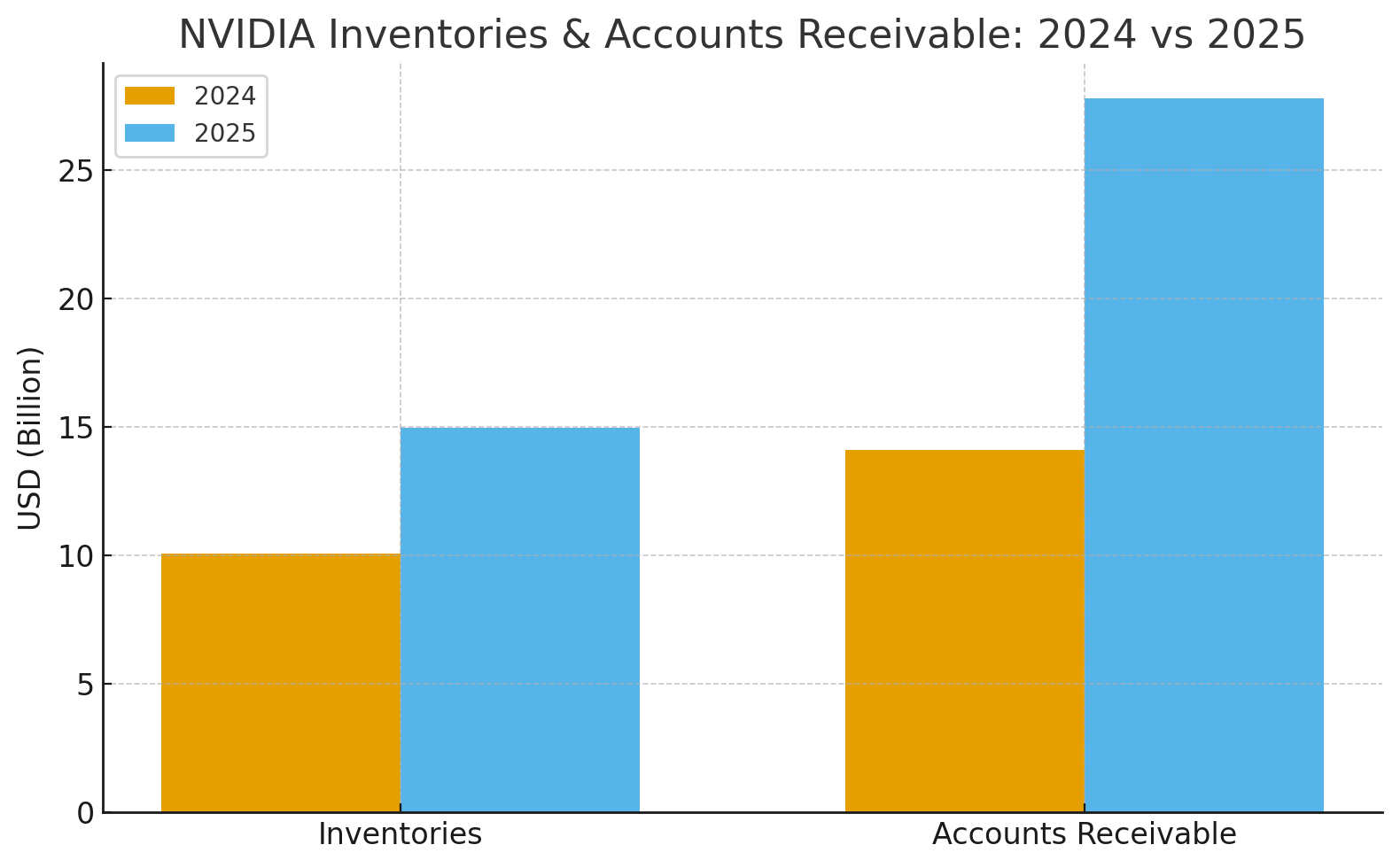
Rising inventories often mean products are piling up faster than they ship, while swelling receivables suggest customers take longer to pay — or that revenue is being booked ahead of actual cash collection. Neither signal fits the narrative of a hyper-tight, supply-constrained supercycle.
Cloude Providers vs. Users
The AI infrastructure race has effectively split the tech universe into two wildly different economic realities.
1. AI Cloud Providers — The Ones Selling the Shovels
(NVIDIA, networking vendors, data-center hardware manufacturers)
These companies earn spectacular margins. NVIDIA’s data-center revenue alone grew over 100% YoY, fueling nearly all earnings upside, Futurum Group reported.
Return economics (approx.):
- For every $1 spent by cloud providers building and selling AI infrastructure,hey capture $0.65–\$0.80 in gross profit.
- High prices, tight supply, and dominant market share keep margins elevated.
In short:
NVIDIA prints money. For now.
— C A U T I O N ! ! ! —
However, this could change in future (2026?), if the ones currently buying NVDA’s showels stop doing so. The figures in NVDA’s balance sheet are indicating that this is already happening…
2. AI Cloud Users — The Ones Trying to Mine the Gold
(Microsoft Azure, Amazon AWS, Meta, Google Cloud, etc.)
This is where the economics get grim. Rothschild & Co. concluded:
- GPU-heavy AI workloads require 6× more capex to generate the same economic output as traditional cloud services.
- For every $1 invested in generative-AI infrastructure, users currently generate only $0.20 in incremental revenue, meaning a \$0.80 loss per dollar spent.
This is why Rothschild downgraded Microsoft and Amazon:
their AI cloud units are bleeding cash, even as NVIDIA sells the tools at premium margins.
The Profit Paradox
Big Tech is plowing \$300 billion+ into AI infrastructure in 2025 alone — with no tangible payoff in sight.
Financial Times
Academic research warns of mounting valuation misalignment in AI-linked stocks — polite language for “pricing detached from reality.”
arXiv – AI Valuation Risk
The Silent Graveyard in NVIDIA’s China Division
NVIDIA’s China business — once a core growth engine — is now being squeezed from both sides of the geopolitical battlefield. Before the most recent wave of export controls, China accounted for roughly 13–17% of NVIDIA’s global sales, making it one of the company’s most important international markets (Reuters; Wright Research).
The U.S. has since tightened the rules dramatically. NVIDIA must now hand over 15% of its China-related AI-chip revenue to obtain export licenses for downgraded accelerators such as the H20 — an unprecedented arrangement described in detail by AP News and The Guardian.
Beijing responded with its own hammer: foreign-made AI chips are now banned from state-funded data centers, a move confirmed by Reuters. At the same time, China is accelerating domestic alternatives such as Huawei’s Ascend line, with U.S. officials estimating Huawei can produce up to 200,000 advanced AI chips in 2025 (Reuters).
Together, these policy shifts are transforming NVIDIA’s China business into a structurally shrinking, politically fragile revenue segment — smaller volumes, stricter controls, and rising compliance costs.
What Happened to NVIDIA Singapore?
For years, Singapore appeared as a massive revenue hub in NVIDIA’s filings, at times exceeding \$10 billion per quarter as a “billing location,” even though over 99% of those chips were ultimately shipped elsewhere (NVIDIA 10-Q).
Then it vanished.
NVIDIA changed its reporting method — from billing location to customer headquarters — which instantly removed Singapore from the geographic breakdown. This shift came precisely when U.S. authorities were examining whether Chinese buyers were routing orders through Singapore to circumvent export controls, a detail highlighted by the Financial Times.
Taken together — the shrinking China market, the 15% revenue skim, China’s localization drive, and the disappearance of Singapore — the message is clear:
NVIDIA’s China division is no longer a growth engine. It is becoming a geopolitical liability.
Verdict: Enjoy the Rally, But Trust the Math
NVIDIA remains the undisputed monarch of AI hardware.
But the fundamentals tell a more complicated story:
- Inventories rising
- Receivables swelling
- AI users losing $0.80 per \$1 invested
- Capex exploding with no matching cash flow
- Profitability concentrated solely at the infrastructure layer, but growing inventories and account receiveables suggest darker clouds ahead.