Market Analysis
Yesterday’s sell-off in the U.S. banking sector sent a stark message: credit stress is spilling over. Regional banks were deeply red across the board, with Zions Bancorp taking a $50 million charge-off on two troubled loans and Western Alliance embroiled in fraud litigation. The KBW Regional Bank Index plunged around 6 %, dragging also on broader markets (Financial Times).
The weakness across the entire Financials sector has been evident since late August, when the group peaked. Now, the downturn in these value-heavy sectors is gaining steam. Notably, there’s been a strong rotation into defensives, right before last week’s sell-off triggered by Trump’s tariff tweets. Informed money already rotated out of their overcrowded Big-Tech AI trades back in September — precisely when the growth sectors peaked.
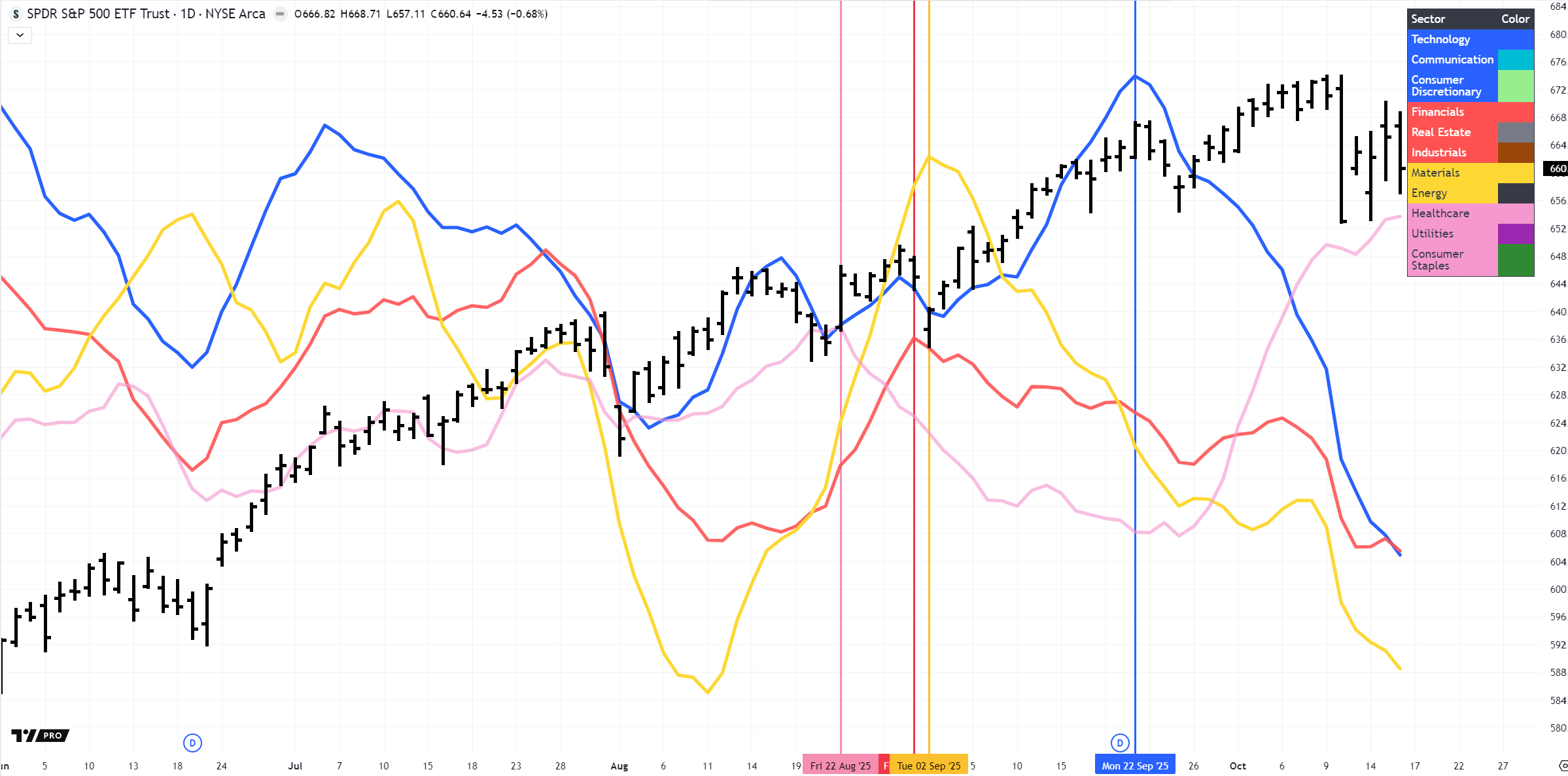
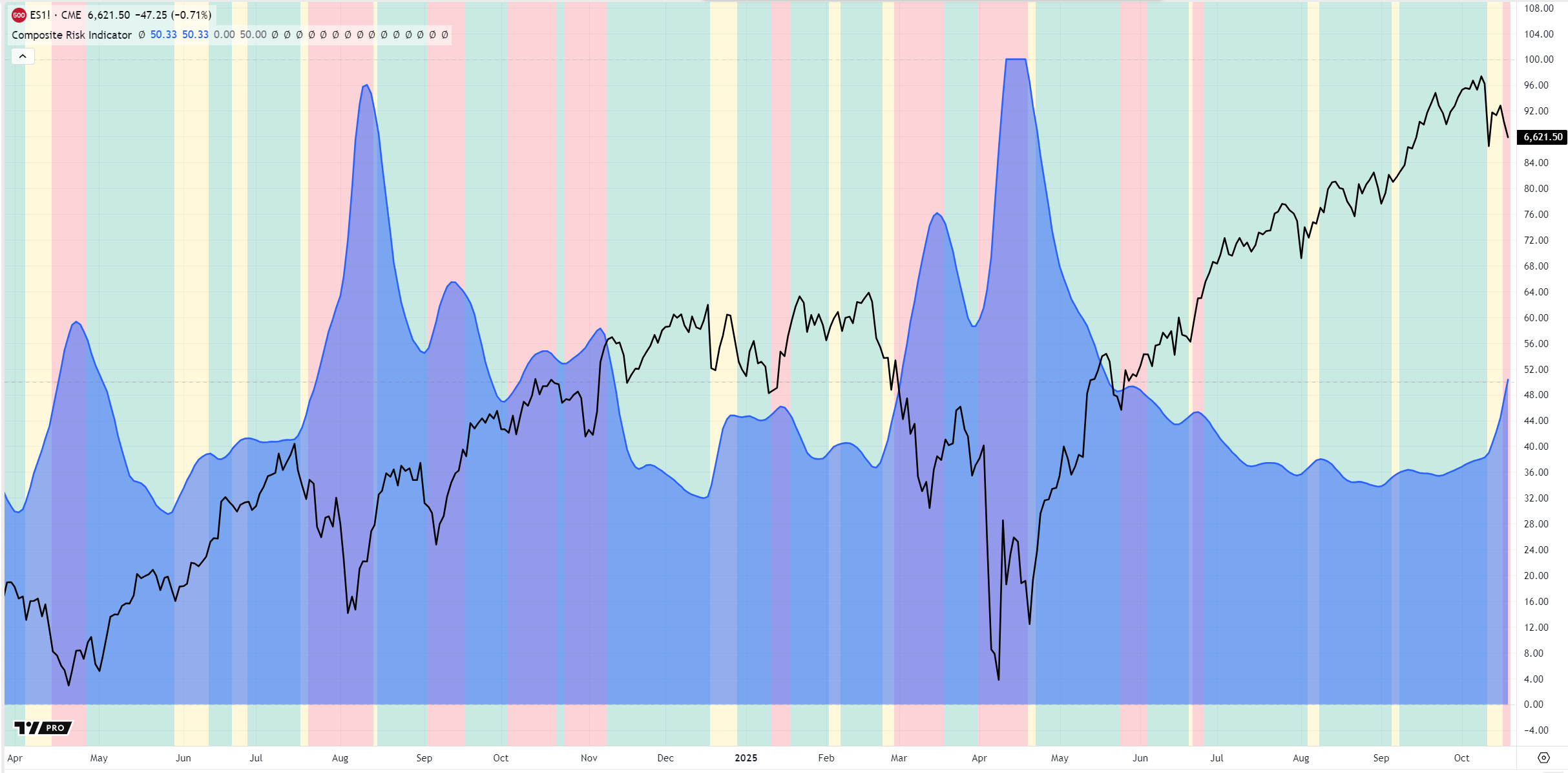
Meanwhile, the VIX volatility index remains stuck above 20, signaling elevated investor fear. The S&P 500 Indicator is deeply red and refuses to recover — partly exacerbated by the U.S. government shutdown, which has halted key economic data releases. Even though some S&P metrics may adjust later, the base-case outlook remains strongly bearish.
The Composite Risk Indicator has now flipped to RED – Bearish, driven mainly by an elevated VIX but also by a rising MOVE index, which measures bond-market volatility.
In several dark-pool trades, institutional players have been unloading regional bank exposure aggressively (especially in XLF and KBE). Traders have noted unusually large dark-pool volumes in these ETFs, suggesting a quiet exit from smaller banks toward perceived “safer” large-cap names. This continues to pressure regional banks ahead of earnings season, as Zions leads off — and investors are selling preemptively rather than waiting for bad news.
Background
We’re seeing warning signs of Silicon Valley Bank crisis, Part II. The 2023 panic was never truly resolved — it was papered over with liquidity and balance-sheet support, leaving structural weaknesses intact. Instead of fixing the root causes, policymakers simply delayed the consequences.
Back then, banks collapsed (SVB, Signature), deposit runs erupted, and regulators rushed in with emergency backstops. Yet the system remains dependent on shadow banking, off-balance-sheet leverage, and non-bank credit intermediation — the very same vulnerabilities that nearly broke it two years ago.
Here are some systemic fault lines that have worsened since:
Consumer & Revolving Credit Stress
This time, defaults may not come from mortgages but from rising consumer debt, credit cards, and auto loans. In Q2 2025, the credit card delinquency rate stood at 3.05 % (seasonally adjusted) — still high versus historical norms (FRED).
The St. Louis Fed reports that the share of U.S. credit card debt 30+ days delinquent has climbed to multi-year highs, nearing 2008 crisis levels (St. Louis Fed, 2025). The Philadelphia Fed notes that more households are struggling to meet payments, reversing post-pandemic improvements (Philadelphia Fed report).
Large bank data from Q1 2025 shows a small improvement year-over-year due to tighter underwriting, but delinquency levels remain far above pre-COVID averages (Philadelphia Fed data).
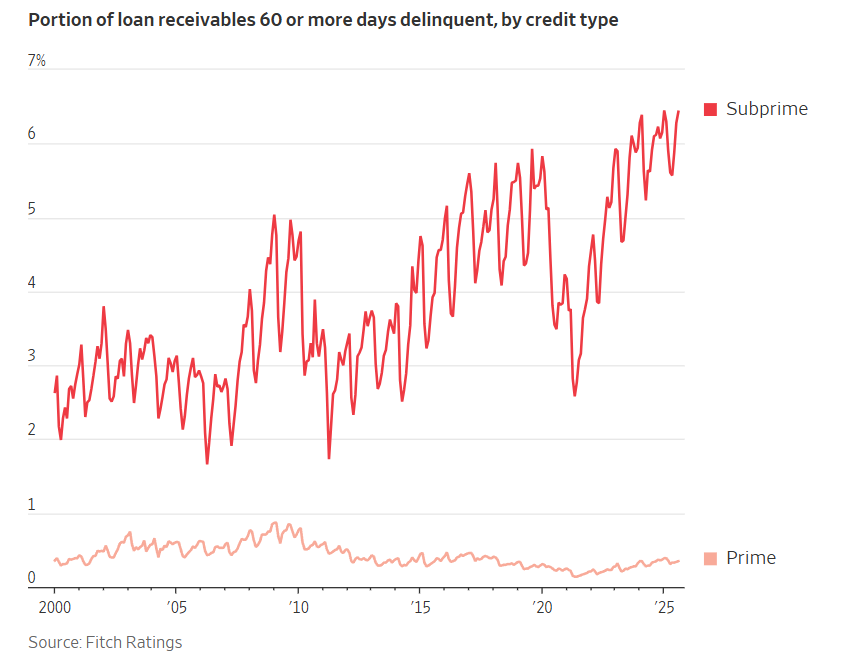
In contrast to the 2007 financial crisis, today’s stress point appears to be subprime auto loans, not mortgages.
According to a Wall Street Journal report, borrowers behind on subprime car payments have surged, with loans 60+ days delinquent hitting multi-year highs.
This reflects growing strain among lower-income consumers who financed costly vehicles during the rate-hike cycle — a clear warning that, this time, consumer credit could trigger the next wave of defaults, not housing.
Economic Downturn & Rising Credit Losses
A recession is no longer a tail risk. With weakening growth, higher unemployment, and tighter credit, most models now point toward a 2025 slowdown.
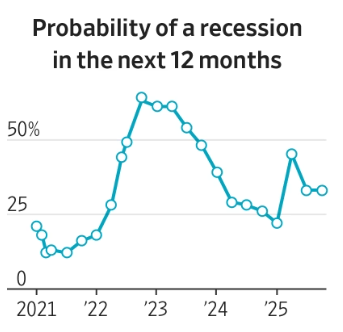
A recent Wall Street Journal analysis shows that the Federal Reserve’s own outlook charts highlight increasing downside risks. Analysts cite a flattening yield curve, sluggish manufacturing data, and declining consumer sentiment.
The probability of a recession in 2025 is now pegged between 40–50 % across major economic models (Conference Board).
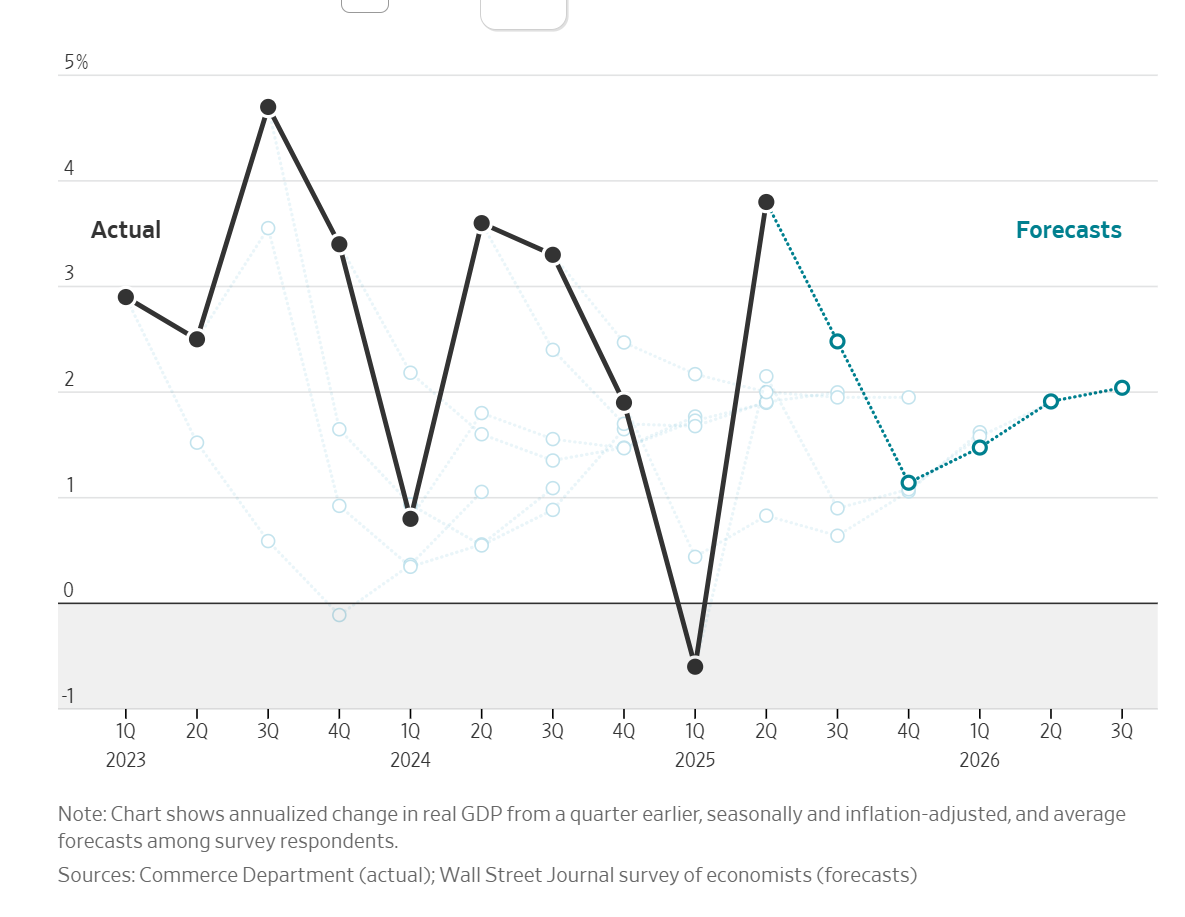
As GDP growth stalls, corporate earnings shrink, and debt service costs rise — defaults are accelerating across sectors.
Commercial Real Estate Despair
The commercial real estate (CRE) market remains in crisis. Office vacancies are soaring, retail space is underutilized, and refinancing risks are mounting.
Hybrid work has permanently reduced office demand, pushing many landlords toward loan defaults. The 2020s are already dubbed the decade of CRE distress (Wikipedia).
Banks — especially regionals — hold the lion’s share of CRE loans. Deloitte forecasts charge-offs to climb, with net charge-off rates reaching 0.66 % in 2025, the highest in a decade (Deloitte Outlook).
This is the spiral: economic weakness → lease defaults → CRE loan losses → bank stress → tighter credit.
The Core Trouble: Non-Bank Credit Markets
What Is the Non-Bank Credit Market?
This is the world of private-credit funds, hedge/debt funds, CLOs, supply-chain financiers, invoice factoring, and other shadow-banking vehicles.
They lend or invest outside the traditional deposit-bank model, relying on institutional capital, securitization, and credit lines rather than depositor funds.
Compared to the regulated banking system, non-bank credit:
- Carries higher yields and greater risk
- Operates under minimal regulation
- Uses more leverage and opaque financing
- Has no central-bank safety net
The IMF and FSB have warned repeatedly that this sector has grown to rival traditional banking in size — exceeding $80 trillion globally (IMF Global Financial Stability Report, Oct 2025).
Key Risks & Linkages
- Liquidity mismatch: illiquid assets, but investors demand daily liquidity
- Valuation stress: mark-to-market losses cascade in downturns
- Leverage & layering: stacked loans amplify small shocks
- Double pledging: same collateral reused across multiple deals
- Bank linkages: exposure via credit lines and CLO tranches
- No safety net: no deposit insurance or central bank backstop
First Brands: A Case Study
The collapse of First Brands, a major auto-parts supplier, illustrates these dangers.
The firm reportedly used off-balance-sheet financing and invoice factoring, possibly even double pledging assets, leading to $2.3 billion in missing funds (Reuters).
Creditors such as Jefferies were hit hard, exposing how deeply intertwined private-credit funds are with the traditional system. Analysts now fear First Brands is just the beginning, revealing systemic cracks across non-bank credit structures.
A failure in the shadows can easily spill into banking, capital markets, and credit spreads.
Outlook
Here’s how the dominoes may fall:
-
Credit Defaults Surge
More consumer, corporate, and CRE loans default — particularly those financed through non-bank channels. -
Non-Bank Credit Stress
Private-credit funds, CLOs, and shadow lenders take losses, face redemptions, and trigger fire sales. -
Bank Sector Transmission
Banks absorb losses through exposure to CLOs, funding lines, and structured credit holdings. -
Investor & Fund Fire Sales
Forced liquidations amplify market contagion, widening credit spreads. -
Equities, Bonds & Safe Havens
Stocks — especially financials and cyclicals — tumble. Spreads blow out, yields spike, and gold and U.S. Treasuries become the only refuge.
If regulators fail to act decisively, Financial Crisis 2.0 may not start in banks — but in shadow banking — and prove just as destructive.
Quick Take
Even if a few wealthy investors keep buying the market higher, they can’t mask the damage that tariffs and economic ignorance are inflicting on the U.S. economy. Once credit begins to break, the entire system follows — because when the middle class runs out of money, and non-AI-hyped companies can no longer fund themselves through inflated stock prices, the illusion of prosperity collapses.