Market Analysis
The SP500 Indicator made a new low but detected a Bullish Impulse, signaling that initial selling pressure is being absorbed by buyers. Similar patterns were observed in June and August 2025, when markets corrected sideways rather than trending lower, suggesting another consolidation phase in the coming weeks. So far, the ES future has failed to close above the key 6700 resistance. Capital flows favor the Russell 2000, which is currently the strongest major index, while the Nasdaq lags behind. Despite September and October’s seasonal weakness, the Fed’s rate cuts could release liquidity still parked in money market funds.
Potential Liquidity Flows from Fed Rate Cuts
With U.S. money market fund assets at a record \$7.3 trillion, even modest reallocations could provide substantial inflows to equities. Just 1% of assets shifting would represent more than \$70 billion of incremental equity demand. Recent flows confirm this pattern, with global investors allocating \$10.65 billion into equity funds in a single week as rate-cut bets intensified (Reuters). At the same time, the Fed continues to shrink its balance sheet through quantitative tightening (Reuters), partially offsetting the effect. The key takeaway: tens to hundreds of billions of USD could be freed up for equities in the coming weeks (Barron’s). Yet, the anticipated cut appears largely priced in. In bonds, risk appetite improved, the MOVE index collapsed to extreme lows, and short-term yields fell most sharply.
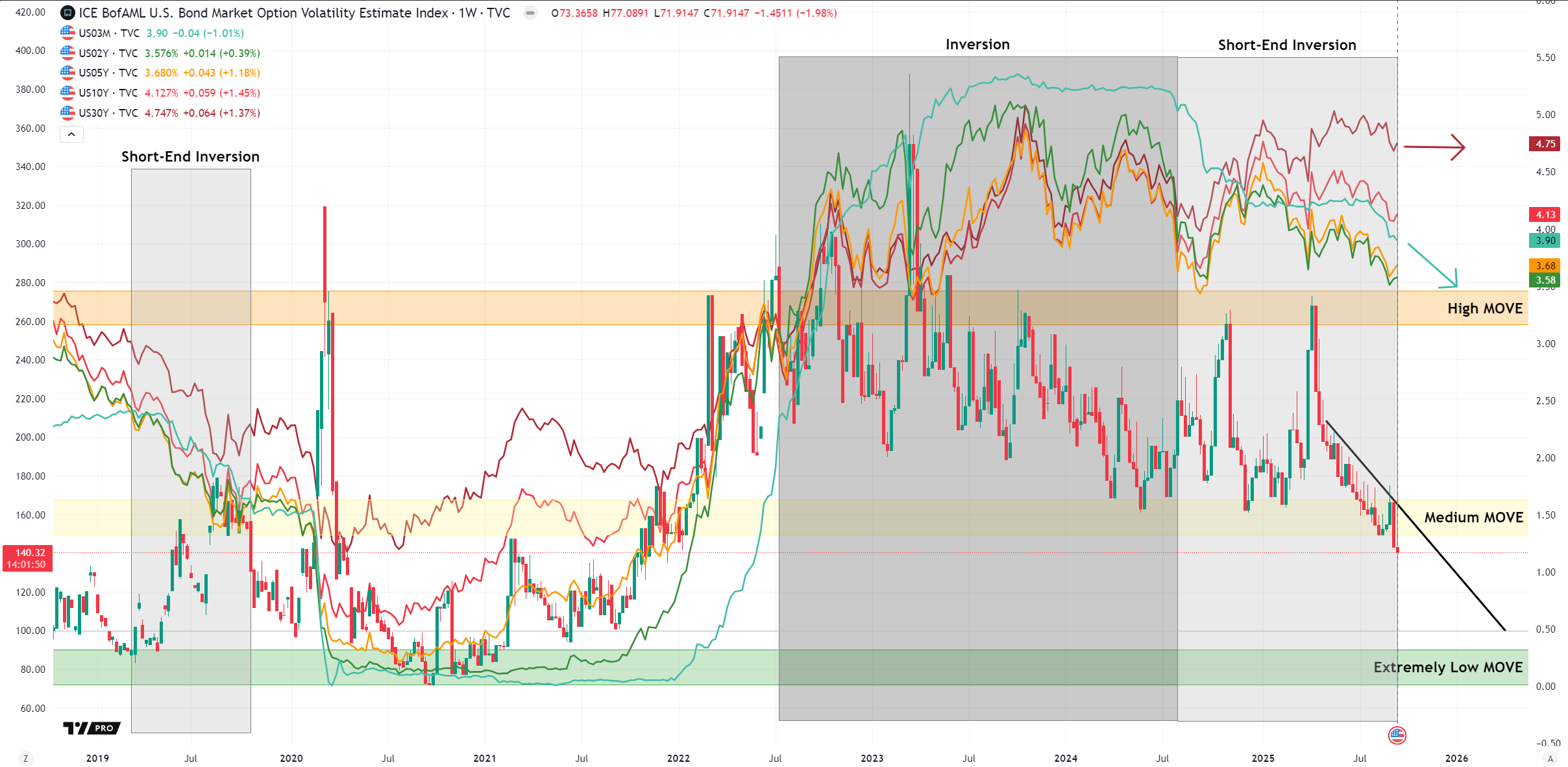
Increased Auction Volume Upcoming of US Treasuries
The U.S. Treasury is set to issue a heavy slate of bills and notes in the coming weeks. An $82 billion 13-week bill and a $73 billion 26-week bill auction are on the immediate schedule (TreasuryDirect). The tentative calendar extends this pattern into October, with steady issuance across short maturities and additional 2-, 5-, 10-, and 30-year auctions (Treasury.gov).
Yield Implications
- Short-term maturities: Elevated bill volumes keep yields under pressure unless demand is strong. Quarter-end liquidity needs could amplify funding stress.
- Longer maturities: The main risk is investor demand—recent weak long-bond auctions underscore vulnerability. Soft bid-to-cover ratios could push 10- and 30-year yields higher (Reuters).
- Curve dynamics: With the Fed easing cautiously, the yield curve may steepen if growth surprises to the upside or inflation proves sticky.
Forward Outlook
Through early October, heavy bill supply will sustain upward pressure on the short end. The next note and bond auctions will be critical—weak demand risks higher yields, while strong foreign participation could stabilize the curve.
Strongest Market Sectors
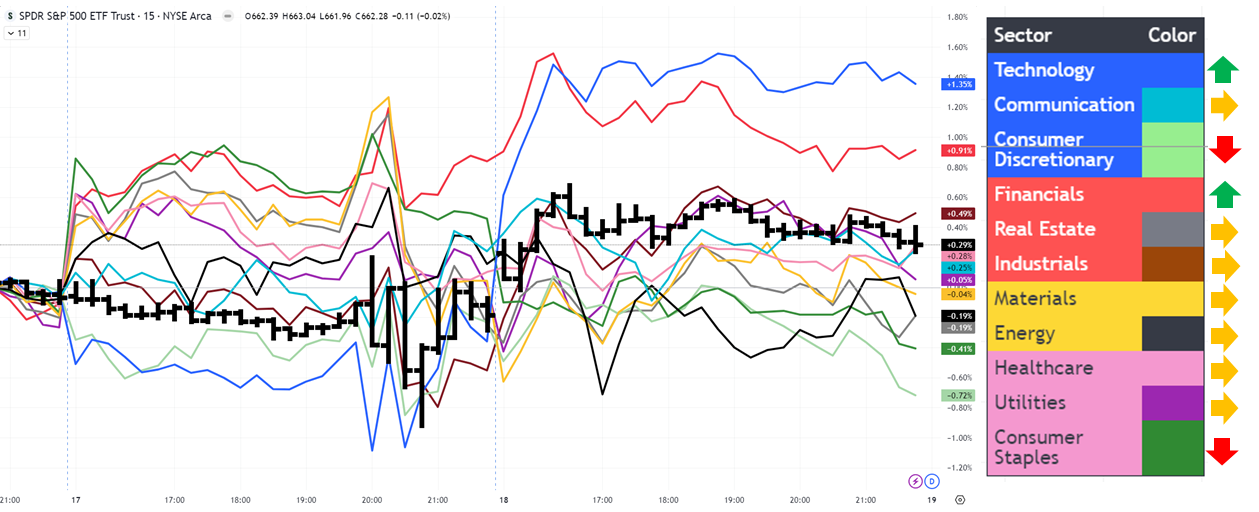
The latest Nvidia collaboration with Intel pushed U.S. semiconductor stocks higher, despite ongoing challenges in the Chinese market. It is arguably only a matter of time before Nvidia’s dominance in AI chips faces serious competition. The stock itself is struggling at the 180 resistance, posting lower highs and lower lows, suggesting momentum has stalled.
Market Leaders Since the Fed Rate Cut
Strongest Sectors
- Technology / Semiconductors – Rate cuts lifted growth valuations; chipmakers surged (Reuters).
- Small Caps – Most sensitive to borrowing costs; Russell 2000 posted new highs (Investors.com).
- Defensives (Utilities, Healthcare, Staples) – Benefited from falling yields and risk-off hedging (Reuters).
- Financials – Some banks gained on lower funding costs, though impact varied.
Standout Stocks
- Intel – Jumped 20–24% on the Nvidia tie-up and rate-cut tailwind (Reuters).
- Nvidia – Still riding AI enthusiasm, boosted by Intel collaboration (WSJ).
- Applied Materials, Lam Research, Micron – Posted 4.5–5.6% gains post-cut (Reuters).
- Vistra, Constellation Energy – Utilities rallied as yields dropped (Reuters).
Market Outlook
With the most recent triple-witching day now behind us, markets are reshuffled and price action today will be a key signal. This session will reveal whether the bullish momentum extends or if profit-taking sets in after record highs in the S&P 500 and Nasdaq.
Looking ahead, at least two more rate cuts are expected in 2025, reflecting the Fed’s response to a slowing but not yet critical economy. Growth-sensitive sectors like technology and small caps have already benefited, while defensives maintain steady inflows. Risks remain: sticky core inflation could delay cuts, and any spike in long-term yields may erode equity optimism.
The outlook into next week is slightly bullish. Tech/AI, financials, and housing should outperform if yields remain contained and data does not surprise to the upside. But stretched valuations leave markets vulnerable to shocks. Key watchpoints will be CPI, PPI, retail sales, and jobless claims, as well as Fed communication.
Caution on bond yields: Fed policy sets the overall direction, but auction supply can amplify moves. If demand falters, yields could climb independently of policy, creating potential headwinds for equities.