Market Analysis
Equity markets were relatively quiet yesterday, with the S&P 500 Indicator edging slightly higher. Sector rotation from Growth into other areas continues, though less pronounced and increasingly visible only in intraday flows:
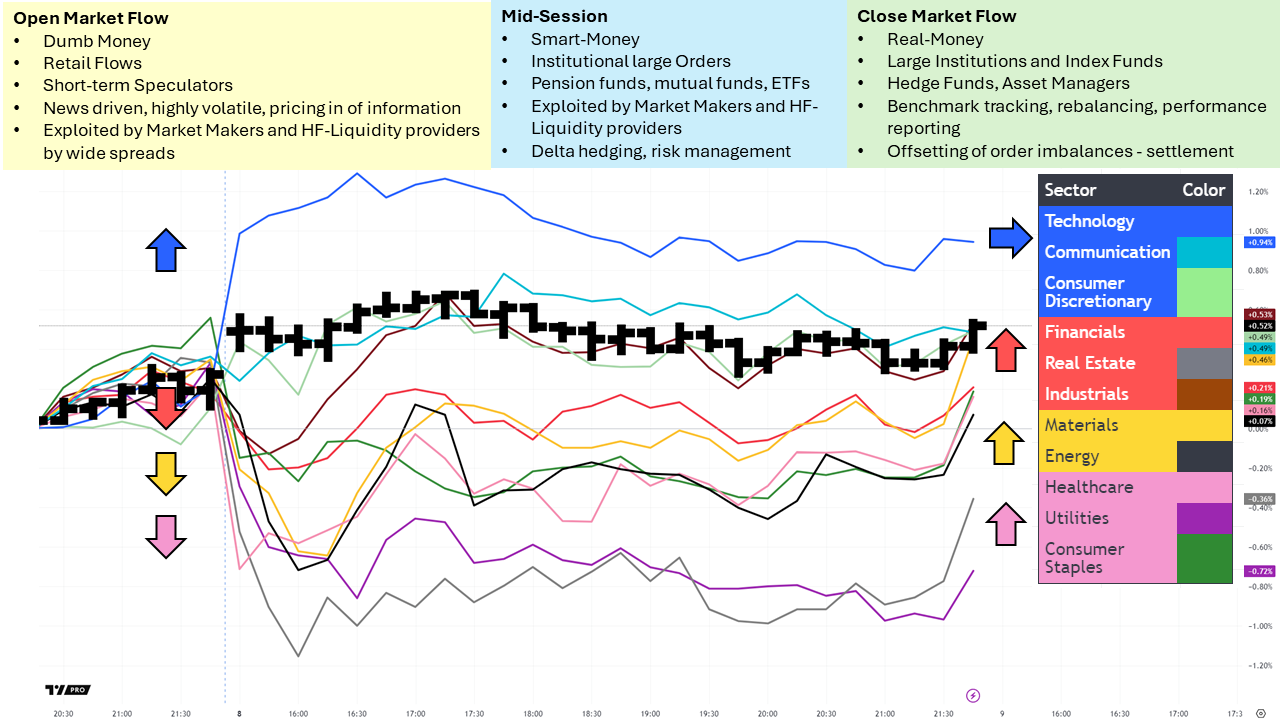
A striking divergence remains between dumb money and smart money positioning. Retail-driven flows dominate at the open, with buyers concentrated in Technology and Consumer Cyclicals. By contrast, into the close we observed a sharp volume spike across Defensives, Financials, and Value sectors — a clear sign of institutional reallocation. Smart money is no longer chasing Tech leadership but instead rotating into rate-sensitive sectors likely to benefit most from an impending Fed rate cut.
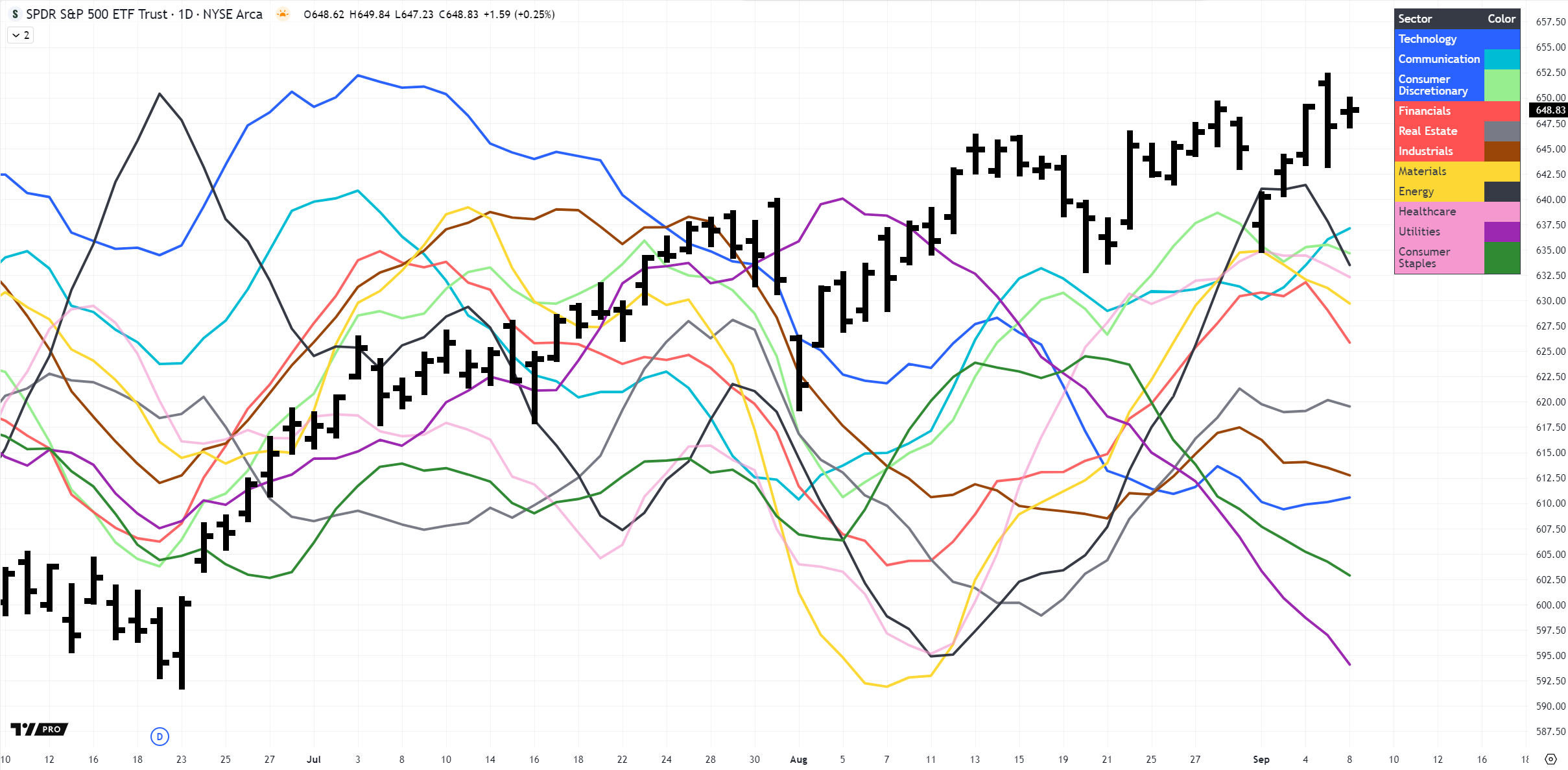
On the daily timeframe, the fading dominance of Technology is apparent. Since early August, most sectors have shifted momentum away from Tech, with two notable laggards standing out:
- Consumer Defensives
- Utilities
The Consumer Defensive sector is underperforming due to cyclical and structural pressures. Tariffs and cost inflation are squeezing margins, forcing companies such as Walmart and Nestlé to absorb costs rather than pass them on. Earnings growth has weakened, restructuring at large staples groups weighs on sentiment, and consumers remain cautious under macro uncertainty. With capital rotating into growth themes like AI and more recently into yield-sensitive sectors such as Value, staples have lost relative appeal — leaving valuations at multi-decade lows. While these headwinds explain current underperformance, the sector still offers long-term opportunity for resilient brands once macro conditions turn supportive.
Meanwhile, Treasuries have been rallying as markets bet on sharper Fed rate cuts after a dismal August jobs report showed only 22,000 new hires and prior months revised into negative territory — pushing 10-year yields to multi-month lows near 4.05% (Investopedia, Barron’s). Record issuance of ultra-short-term T-bills — about $100 billion weekly — is also attracting strong demand as the Treasury lowers funding costs, reinforcing the rally despite rollover risks (Reuters).
This sharp move in yields sets the stage for sector rotation: with Treasuries losing their yield advantage, Utilities, currently the market’s weakest performer, could regain investor interest. Their stable dividend streams, long overshadowed by elevated bond yields, may once again look attractive in a falling-rate environment, potentially driving a rotation back into defensives.
Background Story: Dumb vs. Smart Money
Intraday Patterns of Money Flow
Equity markets exhibit a recurring rhythm of money flow throughout the trading day. While catalysts vary, the type of participants active at different times creates a consistent structure.
At the Open: Noise vs. Information
- Retail flows, overnight adjustments, and momentum chasers dominate — the hallmark of dumb money.
- Market makers and HFTs provide liquidity, widening spreads to offset information asymmetry.
- Institutions rarely act aggressively at the open, preferring to let volatility settle.
Mid-Session: The Institutional Footprint
- Volatility subsides, and institutional execution takes over.
- Pension funds, ETFs, and systematic strategies implement VWAP/TWAP orders.
- Market makers adjust inventory and hedge risk from earlier trades.
Into the Close: Real Money and Auctions
- The closing auction becomes the focal point, dominated by index funds, asset managers, and hedge funds.
- Retail activity fades.
- The close reflects the true intentions of professional capital.
Market Makers and Dealer Positioning
Market makers act as liquidity providers, but their hedging behavior impacts intraday price action:
- At the open: wide spreads, heavy risk management.
- Midday: inventory balancing and delta hedging.
- Into the close: absorbing institutional flows and balancing order books.
When dealers are short gamma, hedging amplifies moves (buying rallies, selling selloffs). When long gamma, they dampen volatility by trading against the move.
Options Flows: The Hidden Driver
Options activity now plays a decisive role in equity market dynamics:
- Explosive growth of 0DTE options has pulled intraday flows forward.
- Dealer hedging frequently dictates the pace and magnitude of spot moves.
- Key strikes act as magnets, and expirations drive sharp adjustments.
- Around macro events (CPI, FOMC, NFP), options flows often overwhelm equity flows.
Takeaway
Intraday money flow is shaped not just by smart vs. dumb money but increasingly by dealer positioning and options flows.
- The open: emotional, reactive flows.
- Midday: disciplined institutional execution.
- The close: real money plus dealer adjustments.
Understanding this rhythm is essential to separating noise from signal in modern markets.
Market Outlook
The current group rotation picture shows limited excitement in broad sectors. Select single stocks may still outperform (e.g., Broadcom versus peers), but overall the market is in the late phase of a bull cycle and entering the seasonally weakest period of the year.
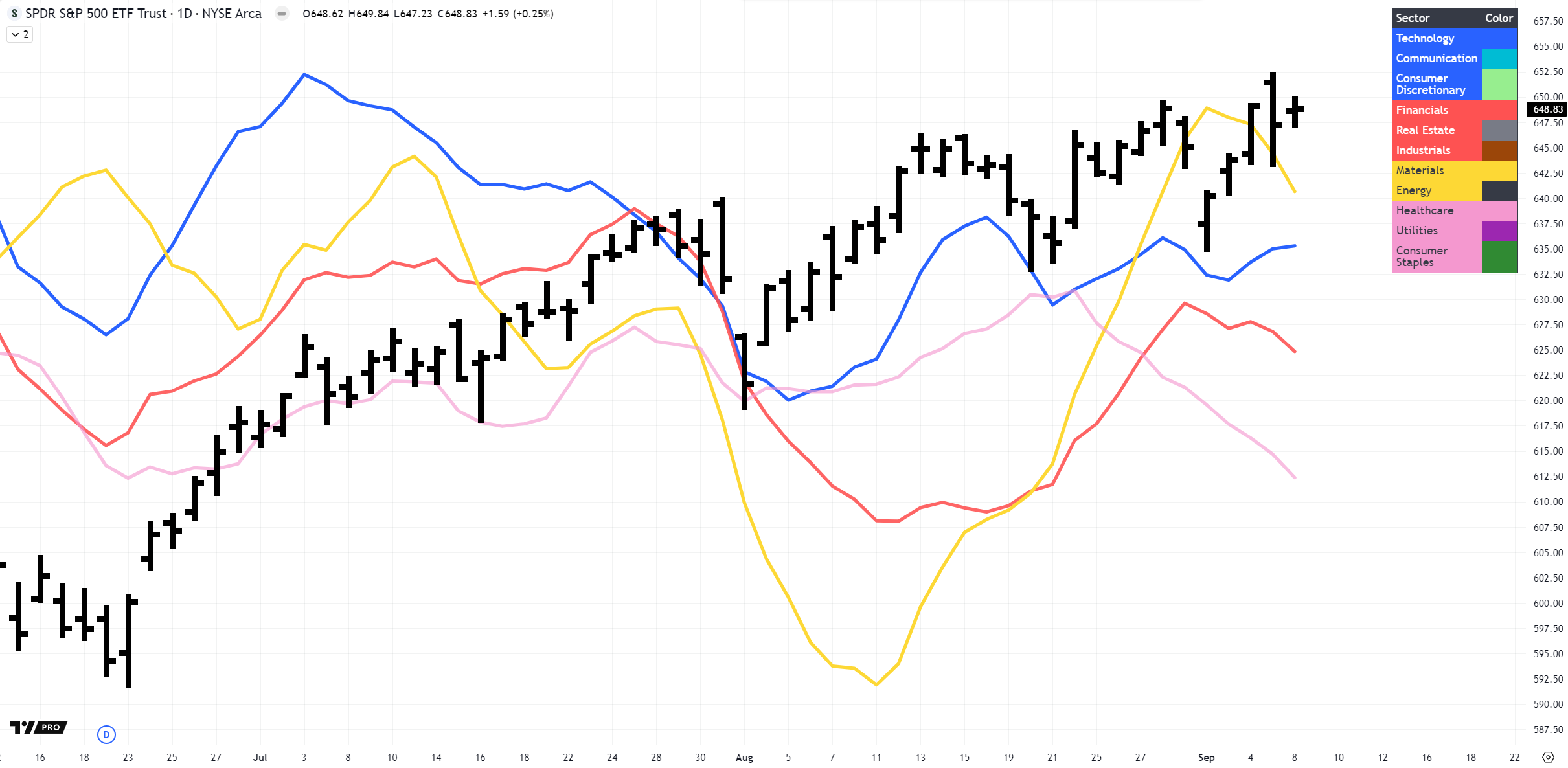
Yes, another all-time high is possible, but expect profit-taking and continued sector rotation.
Economic Events and Data Releases This Week
| Day | Event | Market Expectations | Expected S&P Move (%) |
|---|---|---|---|
| Tuesday, Sep 9 | NFP Benchmark Revisions | Downward revisions of 800k–1M jobs (–75k/month) | ±0.5–0.7% (rate-cut repricing) |
| Wednesday, Sep 10 | U.S. Producer Price Index (PPI) | MoM: +0.3% (after prior 0.9%), YoY: +3.3% | ±0.3–0.5% (inflation sensitivity) |
| Thursday, Sep 11 | U.S. Consumer Price Index (CPI) | Headline 2.9% YoY, Core 3.1% | ±0.5% (major inflation driver) |
| Friday, Sep 12 | U.S. Quarterly Services Survey | Modest improvement in services activity | ±0.2% |
Quick Summary
Markets remain stable with slight gains in the S&P 500 Indicator. Smart money rotation is moving away from Tech into rate-sensitive sectors such as Defensives, Financials, and Value. Consumer Defensives struggle under cost pressures and shifting investor focus, while Utilities may be poised for a rebound as Treasury yields decline. Intraday money flow continues to highlight the divide between retail and institutional activity, with options flows and dealer positioning exerting increasing influence. The week’s key catalysts will be the NFP revisions, PPI, and CPI, all with the potential to shape Fed expectations and drive sector rotation.
The S&P 500’s reaction to today’s NFP benchmark revision will hinge on both magnitude and narrative: a moderate downward adjustment in the range of –500k to –800k jobs *would likely be interpreted as a softer labor market that strengthens the case for Fed easing, fueling risk appetite and supporting a bullish move toward the 6,500–6,600 zone; by contrast, a revision exceeding –1 million jobs could trigger recession fears, shifting the narrative from “Fed stimulus” to “Fed alarm,”** breaking key support around 6,400 and potentially opening the path toward 6,200 or even the 6,000 level.