— date: ‘2025-08-30’ title: “House of Chips: Magnetar, CoreWeave, and the AI Power Struggle” tags: [Magnetar, CoreWeave, Nvidia, OpenAI, Microsoft, Alibaba, Hedge Funds, AI Chips, Financial Crisis, Big Short]
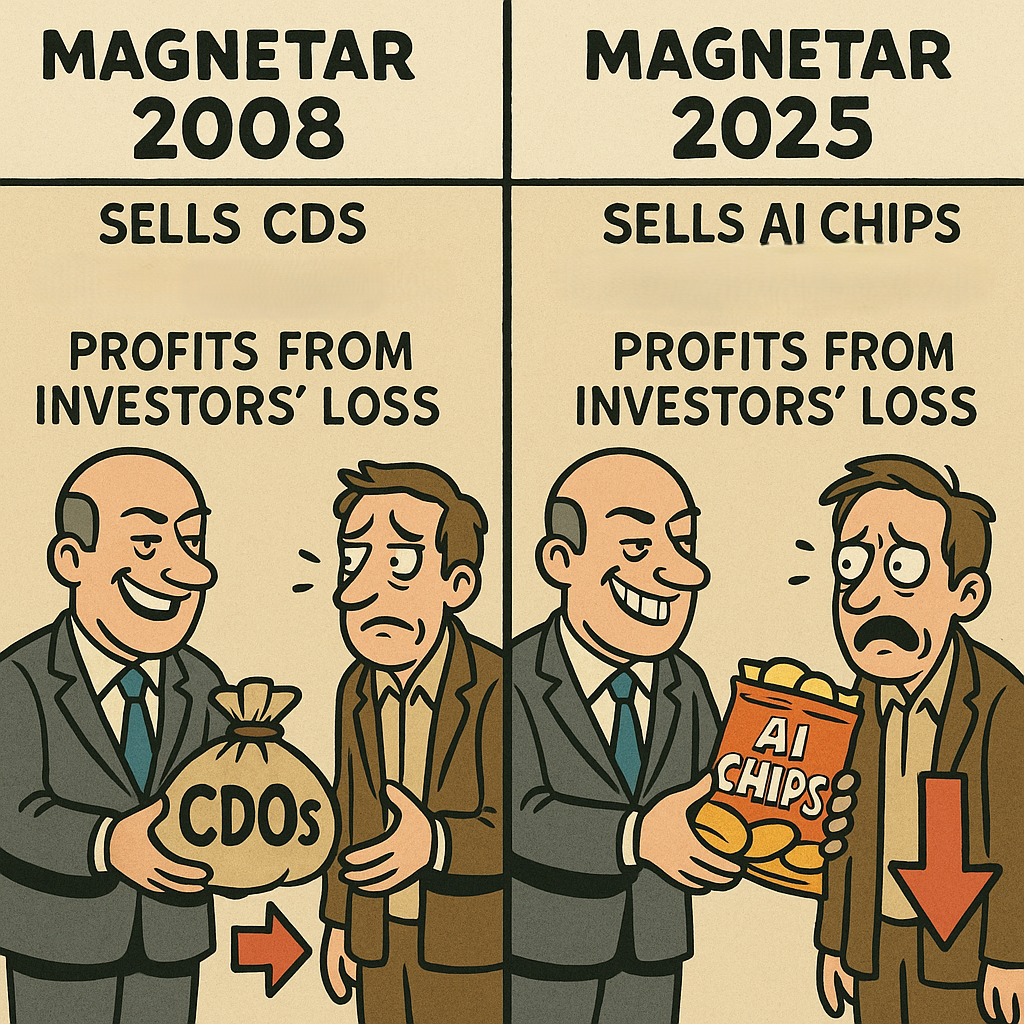
Magnetar Capital, the hedge fund notorious for betting against the CDOs it helped create during the 2008 Financial Crisis (ProPublica), has resurfaced at the center of another high-stakes gamble. Today, Magnetar holds a 30% stake in CoreWeave yet is actively hedging and rotating out of positions, echoing its historic “Big Short” strategy. Meanwhile, Alibaba’s AI chip launch threatens Nvidia’s dominance, and insiders across the tech sector are increasingly selling. Together, these shifts highlight a fragile balance in AI infrastructure, where geopolitics, hedge funds, and insider trades intersect.
The AI “House of Chips” (and where CoreWeave fits)
In the rapidly evolving AI landscape, the interplay between major tech giants is reshaping the global technology ecosystem. This piece explores the intricate relationships between Nvidia, OpenAI, Microsoft, and CoreWeave, with an eye on the shifting dynamics of AI infrastructure.
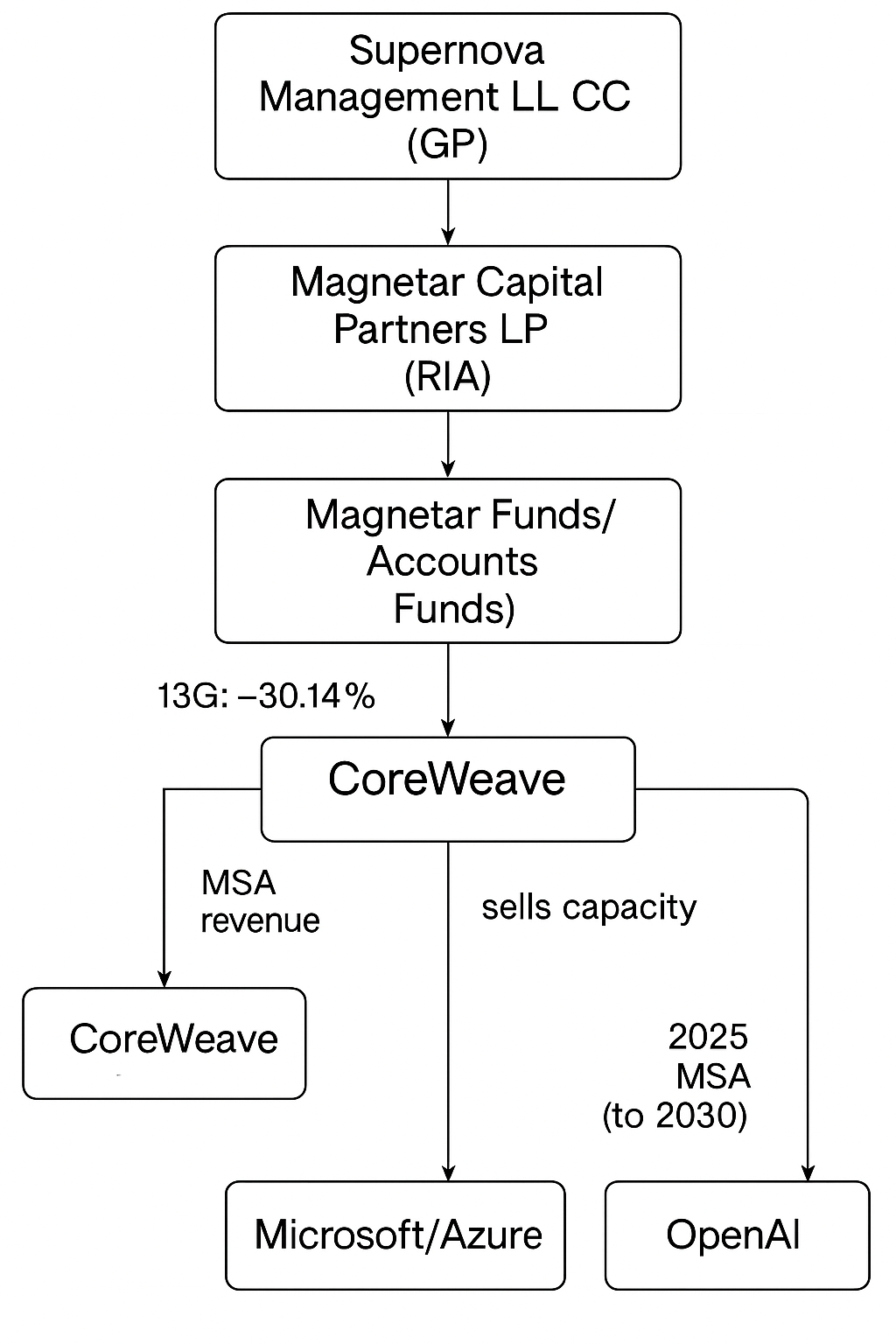
CoreWeave is a specialized AI cloud and GPU infrastructure provider whose top two customers accounted for 77% of 2024 revenue; Microsoft alone contributed 62%. The OpenAI master services agreement (MSA) is expected to broaden this concentration.
- Microsoft ↔ Azure ↔ OpenAI: OpenAI runs major workloads on Microsoft’s Azure; Microsoft is both an investor in OpenAI and CoreWeave’s largest historical customer (35% of revenue in 2023; 62% in 2024).
- OpenAI ↔ CoreWeave: In March 2025, OpenAI signed an MSA committing USD 11.9B through Oct 2030 for CoreWeave capacity, alongside a USD 350M share issuance at IPO.
- Nvidia ↔ CoreWeave: Nvidia is both a >5% shareholder and a customer under an April 2023 MSA (paid USD 320M through 12/31/2024). CoreWeave, in turn, is a major Nvidia GPU operator.
CoreWeave Shareholders: AI Infrastructure or Investment Vehicle?
Institutional Holders (post-IPO snapshot)
- Magnetar (funds/accounts): 30.14%
- FMR LLC (Fidelity): 6.57%
- KOPACC, LLC: 5.32%
- The Linden West Trust: 5.27%
- Nvidia Corporation: 5.18%
- OpenAI: received 8.75M Class A shares at IPO (USD 350M, 1.9% of total).
Key Individual Holders
| Person | CoreWeave Stake | Other companies / background |
|---|---|---|
| Michael Intrator | 11–12 % | Co-founder/CEO; ex-Hudson Ridge Asset Mgmt., ex-Natsource |
| Brian Venturo | 6–7 % | Co-founder/CSO; ex-Hudson Ridge |
| Brannin McBee | 5–6 % | Co-founder/CDO; ex-prop trader Active Power Investments |
| Jack D. Cogen | <5 % | Director/early investor; founder of Natsource, ex-Hudson Ridge advisor |
Hudson Ridge Asset Management focused on alternative investments in energy markets.
Natsource specialized in carbon credit and emissions trading.
Active Power Investments engaged in proprietary trading in technology and finance.
Taken together, CoreWeave looks less like a pure-play AI infrastructure company and more like an investment vehicle for hedge funds and institutions betting on AI’s future. The involvement of Nvidia, OpenAI, and Magnetar makes it both a strategic supplier and a speculative financial asset.
Scale and Risk Analysis of CoreWeave Holders
| Holder | Stake % | Approx Value (@ $100) | Reference denominator | Impact of CoreWeave Bankruptcy |
|---|---|---|---|---|
| Nvidia | 5.18% | $1.79B | Total Assets $111.6B (FY25) | $1.19B loss, 0.25% of revenue |
| Fidelity | 6.57% | $2.27B | AUM $6.4T (6/30/25) | Minimal; portfolio impact only |
| Coatue | 3.6% | $1.78B | AUM $69.5B | Moderate; smaller portfolio hit |
| KOPACC LLC | 5.32% | $1.84B | n/a | Direct loss on stake |
| Linden West Trust | 5.27% | $1.83B | n/a | Similar to KOPACC |
| OpenAI | 1.9% | $0.88B | n/a | Direct revenue + equity impact |
The biggest operational risks fall on Microsoft and OpenAI, as CoreWeave is deeply embedded in their AI infrastructure. For Nvidia, the exposure is financial, but still limited compared to its $130B+ revenue base.
The Nvidia–CoreWeave Loop
Some critics argue CoreWeave and Nvidia’s relationship resembles a Ponzi-like loop:
- CoreWeave buys Nvidia GPUs,
- leases them back into services, sometimes even to Nvidia,
- and finances itself with debt secured by GPUs.
This cycle inflates financial flows but leaves CoreWeave highly exposed to GPU valuations. If AI demand cools or new competitors (like Alibaba) displace Nvidia hardware, the value of GPU collateral could collapse, triggering financial instability.
Magnetar: From the Financial Crisis to Today
The Financial Crisis (2006–08)
Magnetar’s infamous “Magnetar Trade” combined two bets:
1. Seeding mezzanine CDOs (fueling more issuance of risky subprime debt).
2. Shorting them with CDS (profiting when defaults spiked).
When the housing bubble burst, Magnetar lost on its equity tranches but profited massively on its CDS positions.
ProPublica Report
Magnetar Today (2025)
- Structure: Supernova Management LLC is the GP of Magnetar Capital Partners LP (CapEdge).
- Largest shareholder of CoreWeave (30%).
- Recent hedges: collars (calls at USD 175–180, puts at USD 70–75) plus block sales.
CoreWeave Trades and Hedges
- Q2 2025 13F: 870 positions, $20.7B long equity/options; CoreWeave among top holdings (13F.info).
- Aug 28, 2025: Collar (call $175, put $70, exp. Mar-2026) on 91,781 shares; open-market sales at $103 (SEC).
- Aug 18, 2025: Collar (call $180, put $75, exp. Sep-2026) on multiple tranches (SEC).
- Aug 15, 2025: Block sale of 915,767 shares at $100.15 ($92M) (Investing.com).
Positioning: Magnetar remains net long USD 6.8B in CoreWeave, but with small hedges (USD 10M notional). This is a concentrated bet, reminiscent of its crisis-era tactics—profiting from both sides of a trade.
Reports of Insider Selling
Recent filings highlight 200+ insider transactions across tech in 2025, with a strong tilt towards sales/short hedges. Analysts point to insiders rotating out of AI and semiconductor stocks amid valuation concerns.
MarketBeat Insider Tracker
Alibaba’s AI Chip Launch: A Strategic Challenge to Nvidia
Alibaba’s debut of a domestically developed AI chip is a direct move toward China’s tech self-sufficiency. Announced alongside Q1 FY2026 earnings (¥247.65B revenue, slight miss), the chip is designed to compete with Nvidia’s A100/H100 GPUs. Early reports suggest strong efficiency for NLP, computer vision, and robotics workloads (Bloomberg).
- Market impact: Nvidia, AMD, Intel stocks dipped on the news.
- Dell: Server sales plunged 50%, as investors fear demand shifts away from Nvidia-based solutions.
Nvidia Export Restrictions and Smuggling Concerns
Investigations uncovered smuggling of Nvidia H100 and RTX 4090 GPUs into China via Singapore and Malaysia, worth $50M+ (AI Magazine, Al Jazeera).
- Nvidia AI revenue FY2025: $10.3B.
- Potential loss if replaced by Alibaba chips in China: 10–15% decline.
(WSJ, The Diplomat)
Conclusion
The AI chip market has become a geopolitical and financial battlefield. Magnetar, once infamous for profiting from the subprime collapse, now sits at the center of CoreWeave’s rise and potential fall, hedging its bets with echoes of the “Big Short.” Meanwhile, Alibaba’s chip strategy threatens Nvidia’s dominance, insiders are rotating out of tech, and export restrictions raise fresh risks. The AI “House of Chips” is as fragile as it is lucrative—a high-stakes game of innovation, finance, and power.