Market Update
With the S&P 500 Indicator and equities climbing, the sector rotation regime is firmly in place. This rally was not driven by NVIDIA’s earnings, but rather by a series of stronger-than-expected macroeconomic data releases that provided renewed support for risk assets.
1. GDP Revision (Q2)
- Revised up to +3.3% annualized (vs. +3.0% prior, consensus +3.0%).
- Driven by robust consumer spending, solid private investment, and softer imports.
- Tariff Front-Loading effect: Some of the upside reflects businesses and consumers advancing orders before tariffs take hold. This artificial boost is not sustainable once tariffs fully apply.
2. Market Reaction
- Growth at new record highs:
- S&P 500: 6,501.86 (+0.3%)
-
Nasdaq: 21,705.16 (+0.5%)
-
Value and Small-Caps steady:
- Dow Jones: 45,636.90 (+0.2%)
-
Russell 2000: 2,378.41 (+0.2%)
-
Sector Rotation:
- Cyclicals (Industrials, Consumer Discretionary) led gains.
- Big Tech (Broadcom, Alphabet, Amazon) outperformed, while semiconductors lagged.
- Defensives (Utilities, Staples) underperformed as flows rotated toward growth.
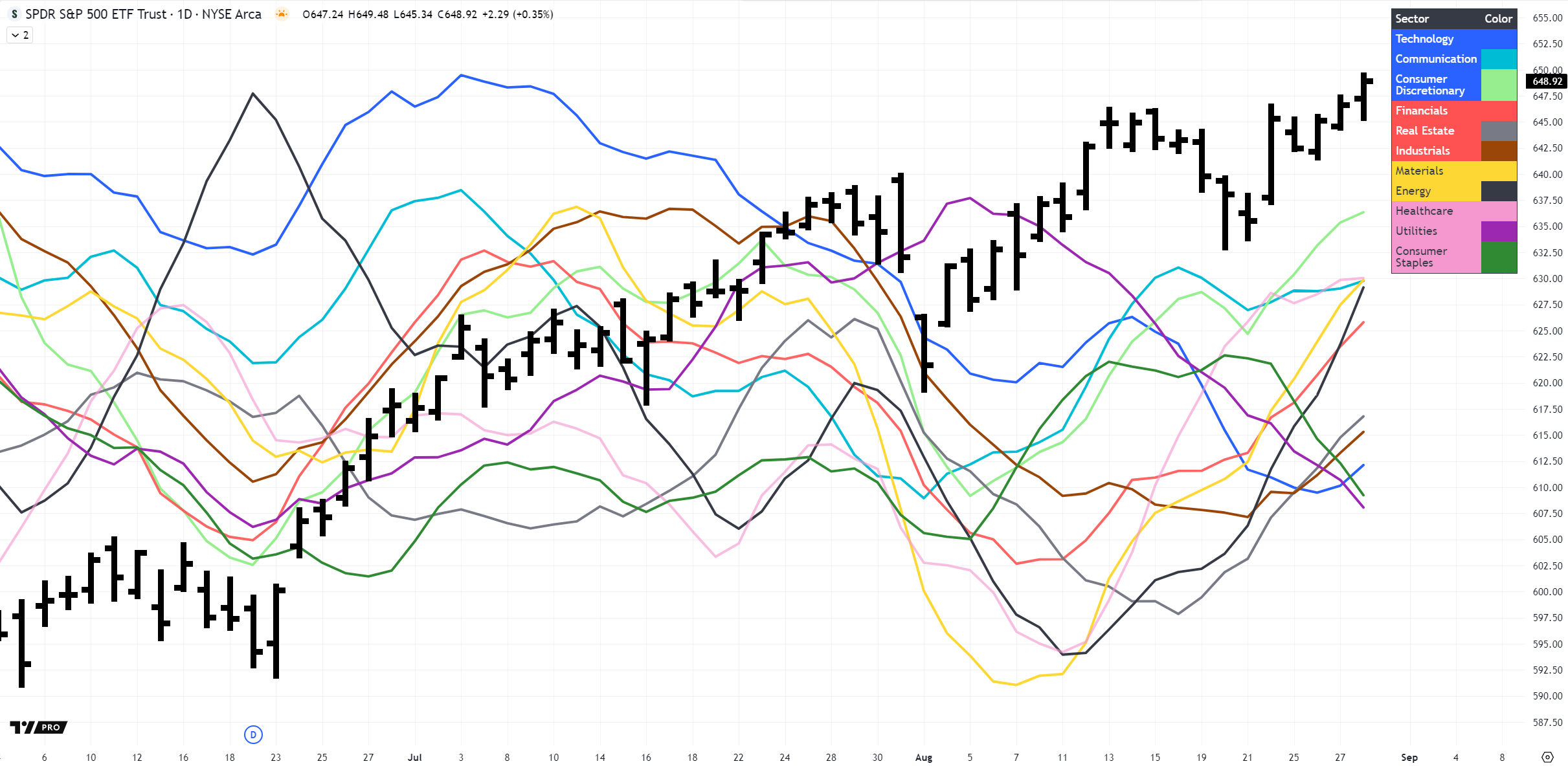
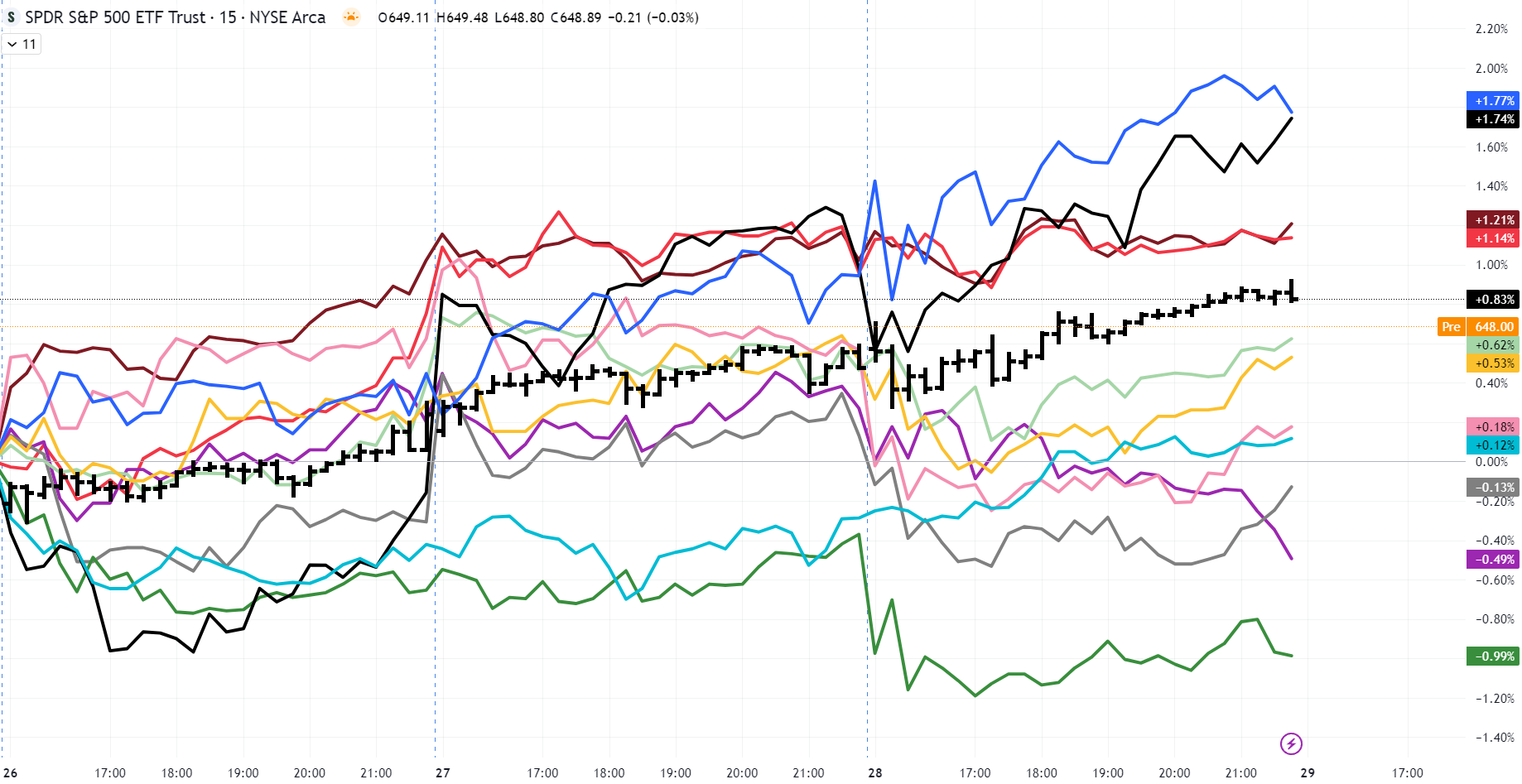
Despite the continuing strenght in Value (Energy, Financials, Materials, Industrials and Real Estate) we se a pick up in Technology and a potential bottoming of the last week’s weakness. Discretionary outperforms Consumer Staples and Utilities are in a strong decline.
3. Why NVIDIA (NVDA) Did Not Rally
Despite meeting expectations, NVIDIA underperformed:
- Valuation stretched: Shares priced for perfection left little room for upside.
- Cautious guidance: Export restrictions and China demand risks flagged.
- Rotation & profit-taking: Institutions trimmed semiconductor exposure after a parabolic run; retail investors absorbed the flow.
Financial Strain & Core Business
- CapEx pressure: R&D and CapEx above USD 9bn last quarter weigh on free cash flow.
- Receivables risk: Extended payment cycles from hyperscalers inflate receivables.
- Data center dominance: 80% of revenue (USD 22.6bn last quarter) comes from data centers, with >60% from the top 5 clients.
- Competition: AMD (MI300X) and custom ASICs (Google TPU, AWS Trainium) erode NVIDIA’s pricing power.
CoreWeave’s Role
CoreWeave has become a critical NVIDIA customer, scaling AI cloud infrastructure:
- Q2 2025 revenue: USD 1.213bn (+206% YoY).
- Net loss: USD 290.5m, improved from –USD 863m in 2024 (Reuters, Bloomberg).
- Debt leverage: Ratio improved from 5.5× (2024) to 3.0× (2025) (GuruFocus).
- Shareholders: Magnetar (26.5%), Fidelity (8.7%), NVIDIA (6%) (Reuters).
- Financing: Over USD 12bn raised, including a USD 7.5bn facility led by Blackstone and Magnetar (Blackstone).
| Metric | 2024 (Full Year) | 2025 (Q2 annualized) |
|---|---|---|
| Revenue | USD 1.92bn | USD 1.213bn |
| Net Loss | –USD 863m | –USD 290.5m |
| Debt-to-Revenue | 5.54× | 3.0× |
Speculation about a Ponzi-like link between NVIDIA and CoreWeave circulates online, but no credible evidence supports this. Business Insider labeled it a “bearish conspiracy” (Business Insider), while CoreWeave’s SEC S-1 Filing and FT analysis highlight legitimate financing and supply dynamics.
4. AI Under Pressure
- Hype cooling: ROI visibility remains limited beyond hyperscalers.
- CapEx moderation: 2025 spending guidance is lighter after heavy 2024 buildouts.
- Regulatory risks: Export controls and EU regulation cloud the outlook.
- Energy strain: AI workloads stretch grid capacity and cooling infrastructure.
5. Labor Market Impact
- AI-linked layoffs in the US reached 10,375 by mid-2025, up from 4,000 in 2024 (CBS News, citing Challenger, Gray & Christmas).
- Most affected: media, tech support, back-office, financial services.
6. Fed Outlook
- A September rate cut remains on the table despite strong GDP.
- The Fed stays data-dependent, with focus on PCE inflation.
- Stable yields reflect balanced risks.
7. Tariffs & End of Front-Loading
- Short-term boost: Q2 resilience inflated by pre-tariff imports and consumption.
- Forward risk: As tariffs bite, imports slow, inventories unwind, and consumption softens.
- Macro implication: Rising stagflation risks (slower growth + higher prices).
📌 Summary and Outlook
Markets continue to benefit from front-loaded growth and strong data, but risks loom as tariffs and AI headwinds converge. Sector rotation currently favors cyclicals and broad tech, while semiconductors (NVDA) underperform. Today’s PCE release will be the decisive catalyst for whether the rally extends into September. The VIX nor the SP500 Indicator are signalling an elevated risk-protection behavior for today.
| Data Release (Aug 30) | Consensus | Market Sensitivity | Likely SPX/ES Reaction |
|---|---|---|---|
| Core PCE (YoY) | +2.6% | Very high | <2.6% = rally; >2.7% = pullback |
| Personal Spending (MoM) | +0.4% | Medium | Stronger = cyclical bid; weaker = defensive bid |
| Personal Income (MoM) | +0.3% | Medium | Stronger = supports demand; too strong = yields up |
| Headline PCE (MoM) | +0.2% | High | In-line = Goldilocks; higher = yields spike |