Divergence between Indicator and Equities
The daily S&P 500 Indicator continued to rise, even as U.S. equity markets pulled back and crypto assets sold off yesterday. The divergence reflects a shift in sentiment: optimism about imminent rate cuts gave way to concerns that tariff-driven inflation could offset the expected easing cycle.
The NQ closed again below the daily MA20. It is likely that the other US-Indices will at least retest this important support line, for the ES the 6400 to 6420 level.
Jackson Hole: Powell’s Balancing Act and the NLP Fedspeak Signal
Markets initially embraced Powell’s Jackson Hole remarks as dovish, but Anna Wong (Bloomberg Economics) offered a more nuanced view. In her post on X, she noted that the NLP Fedspeak Index ticked in a hawkish direction, suggesting that beneath the market’s optimism, the Fed’s language retained a cautious, inflation-focused tone. Historical research from DataTrek shows that U.S. equities usually gain following Jackson Hole speeches; however, 2025 unfolded differently, with weakness ahead of Powell’s appearance, leaving scope for a post-speech rebound.
Key phrases such as “balance of risks appears to be shifting”, “downside risks to employment are rising”, and “policy remains restrictive” illustrate the delicate equilibrium in Powell’s message. He signaled openness to rate cuts, while simultaneously stressing that inflation risks remain elevated. The result was a speech dovish enough to fuel market rallies, yet anchored by hawkish language to preserve the Fed’s credibility and policy flexibility.
Jackson Hole Word Analysis: Dovish vs. Hawkish
A closer look at Powell’s Jackson Hole speech (22 August 2025) confirms a dovish tilt. Word-frequency analysis shows that dovish terms such as “labor”, “employment”, “balance of risks”, and “framework” appeared far more often than hawkish anchors like “inflation”, “restrictive”, and “policy rate”.
| Dovish | Count | Hawkish | Count | |
|---|---|---|---|---|
| TOTAL | 70 | Total | 46 | |
| labor | 12 | inflation | 17 | |
| employment | 7 | policy rate | 4 | |
| balance | 10 | higher | 4 | |
| balance of risks | 4 | restrictive | 3 | |
| maximum employment | 4 | price / prices | 5 | |
| framework / review | 15 | upside | 2 | |
| proceed carefully | 3 | tariffs | 2 | |
| slowdown | 3 | risks to inflation | 2 | |
| softened | 2 | vigilance / vigilance on inflation | 1 | |
| shifting | 2 | prevent ongoing inflation | 1 | |
| neutral | 2 | restrictive stance | 1 | |
| adjustment / adjust | 2 | tightening | 1 | |
| downside | 2 | persistence (of inflation) | 1 | |
| accommodate / flexibility | 1 | expectations (inflation) | 1 | |
| stability (labor focus) | 1 | elevated | 1 |
- Ratio: ≈ 1.75 : 1 in favor of dovish language
Takeaway:
Powell’s Jackson Hole message leaned decisively dovish, highlighting growing sensitivity to labor market risks and openness to policy adjustments, as the balance of risks appears to be shifting (N.B. risk is shifting, not being reduced). At the same time, repeated references to inflation and the “restrictive” stance underscored the Fed’s determination to preserve credibility and optionality. His reference to a “framework review” was not academic, but a clear signal of policy flexibility: the Fed’s strategy—built on average inflation targeting since 2020—may no longer be fully suited to today’s mix of tariffs, shifting labor dynamics, and a higher neutral rate. By invoking a review, Powell indicated that the Fed is prepared to recalibrate its rulebook—placing greater weight on employment risks, tolerating inflation somewhat above 2%, and adapting its toolkit more proactively. For markets, the signal was unmistakable: this is a dovish tilt, preparing investors for potential strategic shifts if economic weakness deepens.
Sector Rotation
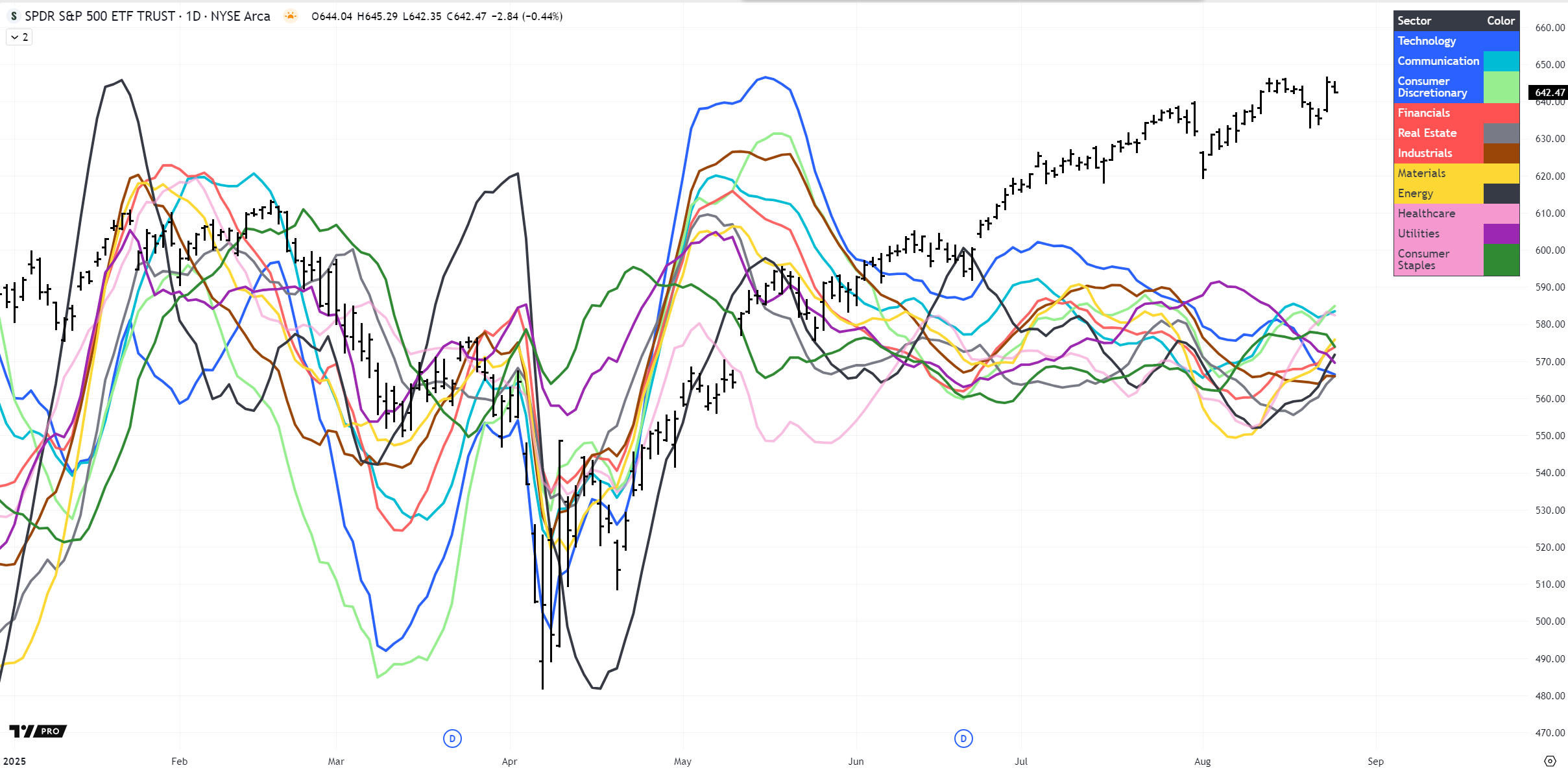
On a longer timeframe, we see the clear loss of momentum of all sector groups. In August a clear shift can be observed, where Defensives have gained momentum. And interestingly also rate-sensitive Value and Cyclicals have been picking up considerably, in anticipation of FED rate-cuts in September.
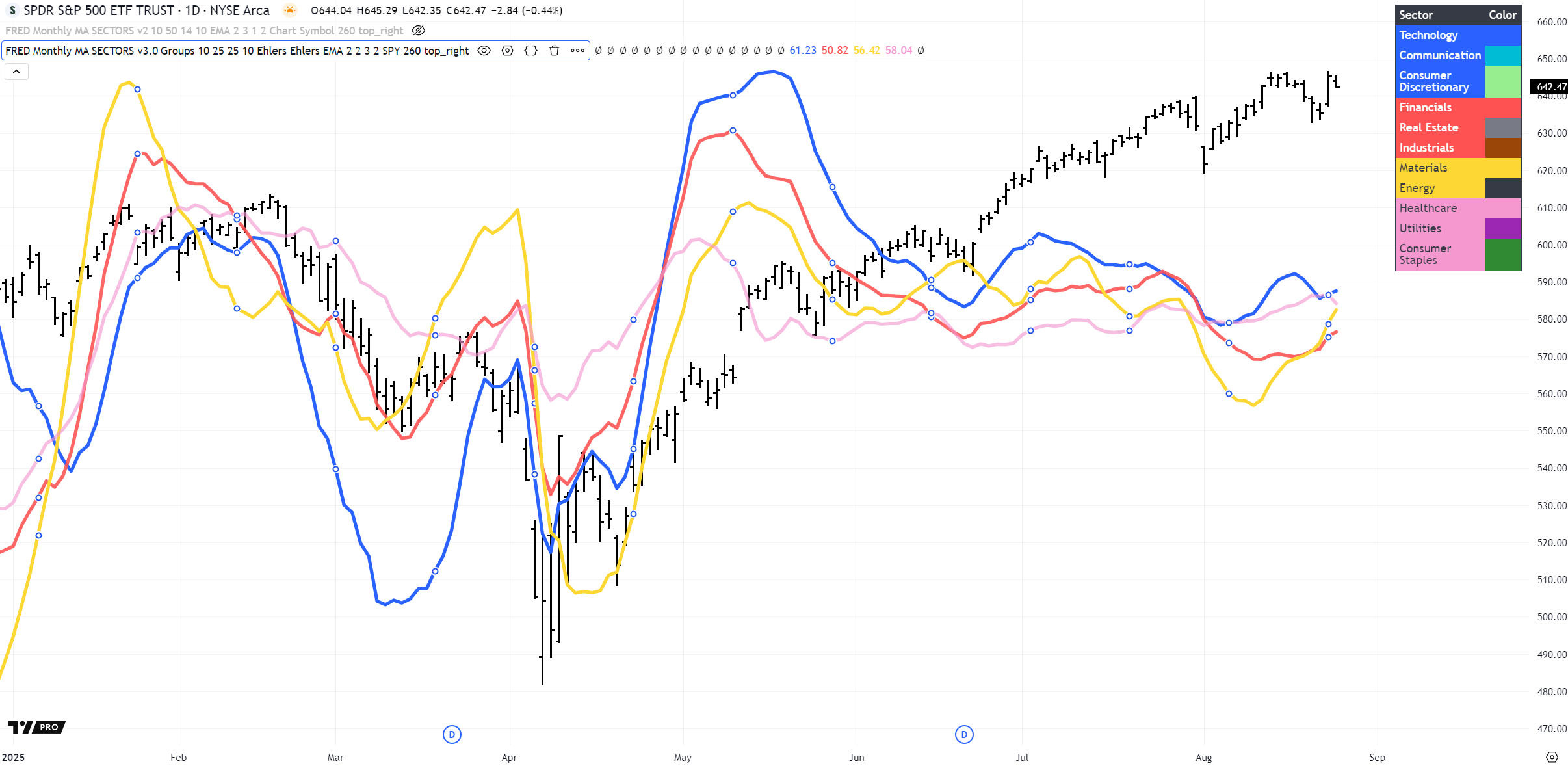 The full sector analysis for 2025 reveals that expecially Healthcare, Energy, Materials and Real Estate are in an upward cycle, together with Financials. This is a comparably new environment to the Big-Tech driven markets of the last months and years.
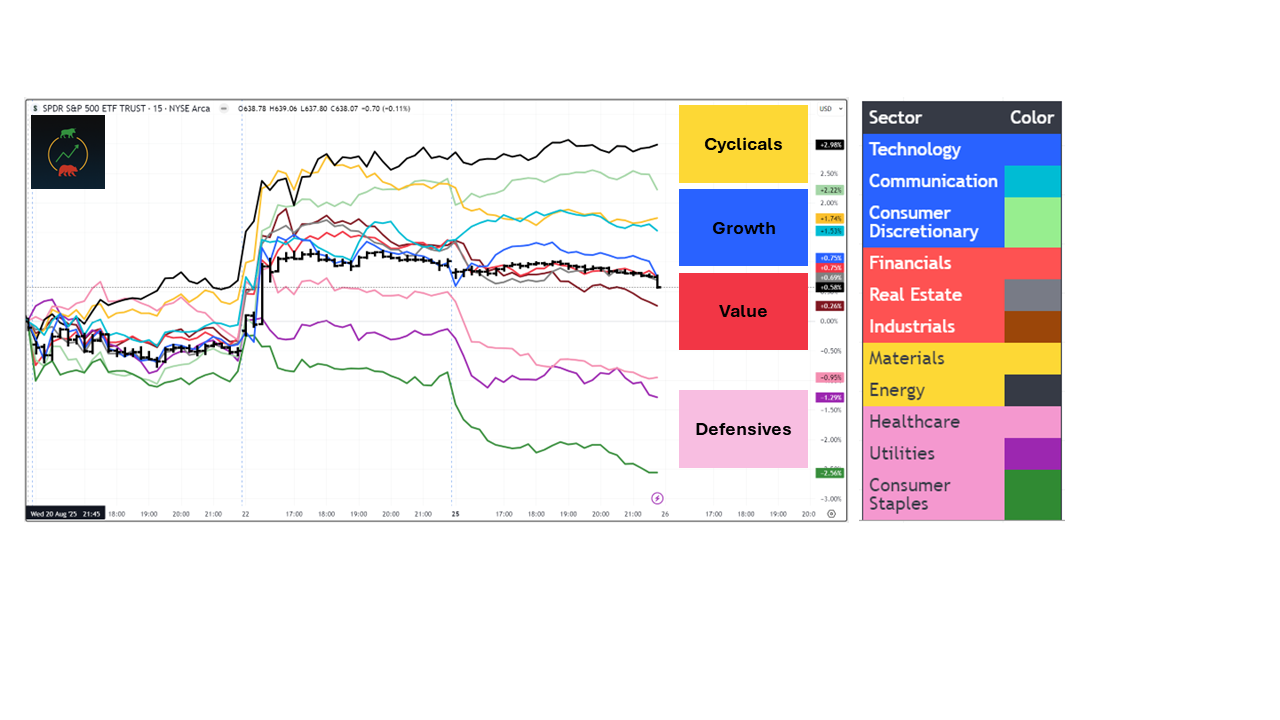
 The Intraday Sector Rotation contrasts the above findings partly and shows that Cyclicals and Growth sectors gained the most on Friday, with Value continuing neutral and Defensives losing strenght. This would in principle signal a risk-on environment, with some major caveats, however:
rate-cuts are expected to benefit value and (non profitable) small-caps the most. However, Monday showed a well-known pattern: roation back into Big-Tech, the save haven against high interest rates.
The Intraday Sector Rotation contrasts the above findings partly and shows that Cyclicals and Growth sectors gained the most on Friday, with Value continuing neutral and Defensives losing strenght. This would in principle signal a risk-on environment, with some major caveats, however:
rate-cuts are expected to benefit value and (non profitable) small-caps the most. However, Monday showed a well-known pattern: roation back into Big-Tech, the save haven against high interest rates.
Market Outlook
Looking ahead, investor focus will shift from Powell’s carefully balanced rhetoric to incoming data. This week’s U.S. labor market releases, consumer confidence numbers, and updated inflation prints will be key in validating the Fed’s dovish lean or reinforcing its hawkish caution. Equity markets may remain volatile as traders weigh the probability of a September rate cut against the risk of persistent tariff-driven price pressures. For now, the S&P 500 Indicator points to underlying resilience, but confirmation will depend on whether the macro data aligns with Powell’s evolving risk assessment.